
Ah, Exodia the Forbidden One. Even after all these years, the mere mention of that name conjures images of unassailable power, instant victory, and perhaps, a touch of childhood wonder. Most of us probably remember watching Yugi putting together this beast when versus Kaiba. For many Yu-Gi-Oh! enthusiasts, the ultimate dream isn’t just to play the five pieces of Exodia, but to actually pull them from booster packs and recreating that iconic moment from the anime. But in 2026, with decades of sets, varying rarities, and shifting print runs, what would it really take to assemble the full Forbidden One from sealed product?
Here at The TCG Times, we love a good challenge, especially one that blends nostalgia with a healthy dose of market reality. While most investors are chasing the latest meta staples or high-end Starlight Rares, our research team decided to tackle a purely hypothetical, yet utterly fascinating, data-driven question: How hard, and how much, would it cost an everyday collector to pull a full, five-piece Exodia set from booster packs in the year 2026?
The TCG Times team understands that this is more of a “fun” exercise than a practical investment strategy. You’re not going to build a deck around pulling Exodia from packs mid-duel (unless you’re playing a very, very casual format with infinite money, if this is you, we are all jealous). But the underlying numbers offer a stark reminder of pull rates, scarcity, and the ever-present allure of the chase that defines our hobby.
The Pieces of the Puzzle: Exodia’s Reprint History
First, let’s establish our parameters for this grand quest in 2026. We’re looking to pull all five pieces:
- Exodia the Forbidden One (Head)
- Right Arm of the Forbidden One
- Left Arm of the Forbidden One
- Right Leg of the Forbidden One
- Left Leg of the Forbidden One
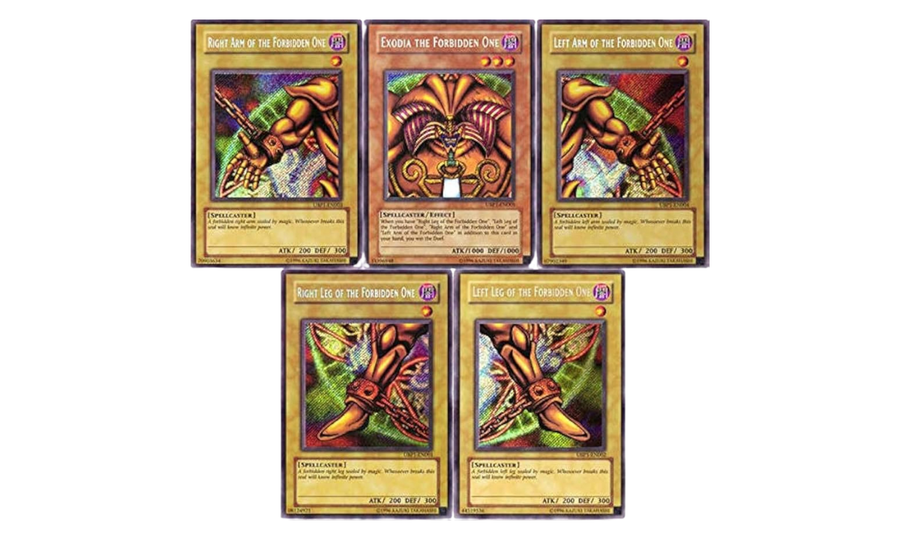
Exodia cards have been reprinted numerous times across various sets, ranging from common to Ultra Rare. For the sake of this challenge, we’re going to focus on the most accessible (and therefore, most likely to appear in any given pack) rarity: Common. Why common? Because trying to pull five specific Ultra Rares from random sets would be near impossible and ridiculously expensive. Even targeting commons is a monumental task.
However, here’s the kicker: Exodia cards aren’t in every set. They appear sporadically in reprint sets, special collections, and sometimes as standalone promos which are even harder to get your mitts on. For our 2026 scenario, we’d need to identify which active sets are likely to contain common versions of Exodia pieces. This is where the challenge truly begins.
The Math of the Forbidden One (A Rough Estimate for 2026)
Let’s assume, for our 2026 scenario, that Exodia pieces are available as commons in a few key reprint-focused sets. For instance, sets like Battles of Legend or Legendary Duelists series often include older, iconic cards. Let’s make a very generous (and hypothetical) assumption about future product releases:
- Average Pack Cost (2026): Let’s estimate an average booster pack price of $4.50 – $5.00 USD. Inflation, you know how it goes.
- Common Pull Rate: In most Yu-Gi-Oh! sets, you’re guaranteed several commons per pack. However, getting a specific common is where the odds get tricky. A typical set might have 40-50 unique common cards. Although, it may feel like you get 4/5 of the same card every couple packs, we know the feeling.
- Exodia Availability: This is the biggest variable. Exodia pieces are almost never all in the same set as commons. You might get an arm in one set, a leg in another, and the head in a third, all released at different times. Or just 3 left arms…
To simplify for our thought experiment, let’s pretend (optimistically) that in 2026, Konami releases a hypothetical “Forbidden One Collection” set where all five Exodia pieces could theoretically be pulled as commons, alongside 45 other common cards, making a total pool of 50 commons.
The probability of pulling any one specific common from a pack with 5 commons out of 50 unique commons is roughly (5/50) = 1/10 per common slot. Given a pack has 5 commons, your chance of getting at least one specific common in a pack is higher, but the chance of getting all five specific Exodia pieces is crazy low from a single pack. From what we know, it’s never happened.
The True Cost: Thousands of Packs, Tens of Thousands of Dollars
Now, for the grim reality. To pull a full playset (three of each card) of every common in a 100-card set, you’d typically need to open hundreds of booster packs. For five specific commons, it would still take an incredible number of packs.
Let’s break it down by piece for our hypothetical 2026 scenario:
- Average Packs to Pull One Specific Common (e.g., Right Arm): Based on statistical averages for common cards in sets where they’re included, you might expect to pull one copy of a specific common every 10-15 packs, assuming it’s equally weighted.
- Packs Needed for ALL Five Pieces (if in the same set): Even if all five Exodia pieces were in the same hypothetical 2026 set as commons, and you needed one of each, you’d still likely need to open hundreds, if not over a thousand packs and if you have “bad pack luck” maybe even more, to assemble the full set by chance. The statistical variance is huge, and you’d likely end up with dozens of some pieces before seeing others.
- The Realistic Scenario (Multiple Sets): The TCG Times team knows that Exodia pieces will likely be spread across multiple sets throughout 2026. This means buying packs from Set A for the Right Arm, Set B for the Left Leg, Set C for the Head, and so on. This multiplies the cost dramatically, as you’d be chasing different pieces in entirely different product lines.
If we conservatively estimate that you’d need to open around 200 packs per specific Exodia piece (across whatever relevant sets they appear in) to reliably pull at least one common copy, and assuming these pieces are spread across different active sets:
- Total Packs: 5 pieces * 200 packs/piece = 1,000 booster packs.
- Total Cost: 1,000 packs *
5.00/pack=∗∗5.00/pack=∗∗5,000 USD.**
And this is a conservative estimate for just pulling common versions! The actual cost could easily spiral into $10,000 – $15,000+ USD if you encounter bad luck, or if some pieces are in rarer printings within their respective sets.
The TCG Times’ Verdict: Buy Singles, Enjoy the Dream
So, is it impossible for the everyday collector to pull a full Exodia from packs in 2026? Statistically speaking, it’s monumentally difficult and prohibitively expensive. This isn’t just about Yu-Gi-Oh!; it’s a testament to the economics of TCG booster packs.
The TCG Times team’s advice is clear: cherish the dream, but embrace reality. If you want to assemble the Forbidden One for your collection or for casual play, the singles market is your friend. You can pick up a full common set of Exodia for less than the cost of a single booster box today, and likely for a fraction of what you’d spend chasing it in 2026.
The thrill of opening packs is undeniable, and that’s a joy worth pursuing. But when it comes to completing a specific, multi-piece objective like Exodia, our data-driven look at 2026 confirms that the wisest path is often to appreciate the art, enjoy the chase, and secure your specific needs through targeted single purchases. Unless you have the limitless wealth of a certain fictional CEO (surely you know who were talking about), the Forbidden One will remain very much forbidden to most pack-opening endeavours.