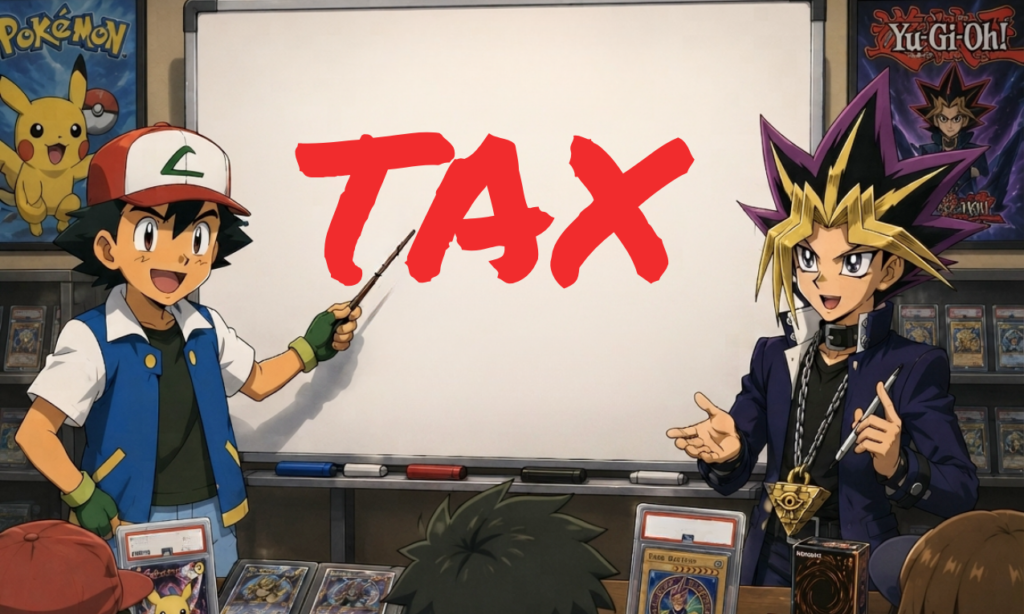
Here is a conversation we suspect very few collectors have had with themselves: “I just sold a card for $400 profit. What do I owe the government?” Most people in this hobby are thinking about pull rates, price trends, and what to buy next, not about tax obligations. And honestly, for the casual seller moving a few cards a year, the impact may be minimal, or zero impact at all. But for anyone building a serious collection, regularly flipping cards, or holding high-value assets they plan to sell, this is a conversation worth having before the taxman has it for you. Better to be safe than sorry.
Here at The TCG Times, we want to be clear upfront: this article is an overview, not advice. Tax law varies enormously by country, changes regularly, and your personal situation matters more than any general principle we can outline. What we can do is make sure you walk away knowing the right questions to ask a professional in your own jurisdiction, because right now, there is a good chance you are not asking them at all.
The Universal Principle: A Sale Is Usually a Taxable Event
Regardless of where you live, most countries treat the sale of a valuable asset, and yes, that can include trading cards, as a taxable event if you made a profit. The specific rules around rates, exemptions, and thresholds differ dramatically, but the underlying principle is almost universal… if you bought a card for $50 and sold it for $300, that $250 gain exists in the eyes of your tax authority, and it may well be taxable.
The distinction that matters most in almost every country is whether your card activity is classified as a hobby, an investment, or a business. Each is treated differently, and getting this wrong can be costly.
🇺🇸 United States
In the US, trading cards fall under the IRS classification of collectibles, and this is a category with its own specific tax rules that catch a lot of people off guard.
Long-term capital gains on collectibles (assets held for more than one year) are taxed at a maximum rate of 28%, significantly higher than the 15–20% long-term rate that applies to most stocks and ETFs. Short-term gains, on cards held for less than a year, are taxed as ordinary income, which means they are added to your regular income and taxed at your marginal rate, which can be up to 37% for high earners.
The hobby vs business distinction matters here too. If you are occasionally selling cards as a hobbyist (occasionally selling a couple of items a year for fun to mates), you report gains as capital gains. If the IRS determines you are operating a business (consistent profit motive, volume, business-like record-keeping), income is treated as self-employment income, which carries its own additional tax obligations. The line between the two is not always obvious, which is exactly why professional guidance is worth it.
🇬🇧 United Kingdom
UK collectors should be aware of Capital Gains Tax (CGT), which applies to profits from selling assets. The good news is there is an Annual Exempt Amount, an allowance before CGT kicks in. However, it has been cut dramatically in recent years, from £12,300 in 2022/23 down to just £3,000 for the 2024/25 tax year onwards. For anyone selling multiple cards in a year, this threshold can be reached faster than you might think, especially considering £3,000 could be only 1 sale.
CGT rates on assets like collectibles are 10% for basic rate taxpayers and 20% for higher and additional rate taxpayers in the UK. If HMRC determines you are trading cards as a business rather than as an investor, income tax rates apply instead, which are higher.
Keep records of what you paid for cards and what you sold them for. Without a cost basis, proving your actual gain becomes very difficult. Even just a basic Google spreadsheet can save you hours of hassle later on.
🇦🇺 Australia
Australia does not have a separate capital gains tax, CGT is instead incorporated into your income tax return and taxed at your marginal rate. However, there is a significant benefit for long-term holders: Australian residents receive a 50% CGT discount on assets held for more than 12 months, meaning you only include half the gain in your assessable income.
The ATO (Australian Tax Office) does have exemptions worth knowing about. Cards acquired for $500 or less as collectables, or personal use assets acquired for $10,000 or less, may have their capital gains disregarded. However, if you are acquiring cards as a deliberate investment, and reading this site, you likely are, the ATO would likely treat them as investment assets rather than personal use items, meaning the standard CGT rules apply.
As with the US and UK, the hobby vs business distinction matters. If you are operating at a commercial scale, the ATO may classify your activity as a business, making your gains fully taxable as ordinary income without the 50% discount.
🇨🇦 Canada
Canada taxes capital gains with a 50% inclusion rate for individuals, meaning only half of your capital gain is added to your taxable income and taxed at your marginal rate. The proposed increase to 66.67% for gains above $250,000 that was floated in the 2024 Budget was cancelled in early 2025, so the 50% rate currently applies for individual taxpayers.
Again, if the CRA views your activity as a business rather than personal investing, the full gain becomes business income, no 50% inclusion rate, and no discount.
The Record-Keeping Rule: Universal and Non-Negotiable
Wherever you are in the world, there is one piece of practical advice that applies to every single TCG investor without exception: keep records. Log what you paid for every card, when you bought it, when you sold it, and what you received. Screenshots of purchase receipts, eBay/TCGPlayer order histories, PayPal or bank transaction records… all of it. The cost basis is everything when calculating your actual gain, and without records, you may end up being taxed on the full sale price rather than the profit.
And “keeping record” isn’t hard, just an Excel or Google sheet with some minor organisational skills will have you ahead of the tax man. A simple spreadsheet with purchase price, date, sale price, and date is enough to start. Build the habit now, before your collection reaches a scale where reconstructing records becomes a nightmare…. trust us, it happens quick!
The TCG Times’ Verdict: Get Informed Before You Get Surprised
We are not trying to put a dampener on your love of the hobby (and making money). Quite the opposite. Both collectors and investors, who understand their tax position, are the ones who can plan around it, timing sales, understanding holding periods, and making informed decisions rather than reactive ones.
If you are selling cards regularly or sitting on a collection with significant unrealised value, speaking to an accountant or tax professional in your country is not overkill. It is just sensible investing. The potential cost of that conversation is nothing compared to the cost of getting it wrong at scale.
The market rewards the patient and the prepared. Make sure your preparation extends beyond the cards themselves.
⚠️ Important Disclaimer: The TCG Times is a news and educational platform. The information in this article is general in nature and does not constitute tax advice. Tax laws vary by country, change regularly, and depend heavily on individual circumstances. Always consult a qualified tax professional or accountant in your own jurisdiction before making financial decisions based on tax considerations. Nothing in this article should be relied upon as professional tax or financial advice.