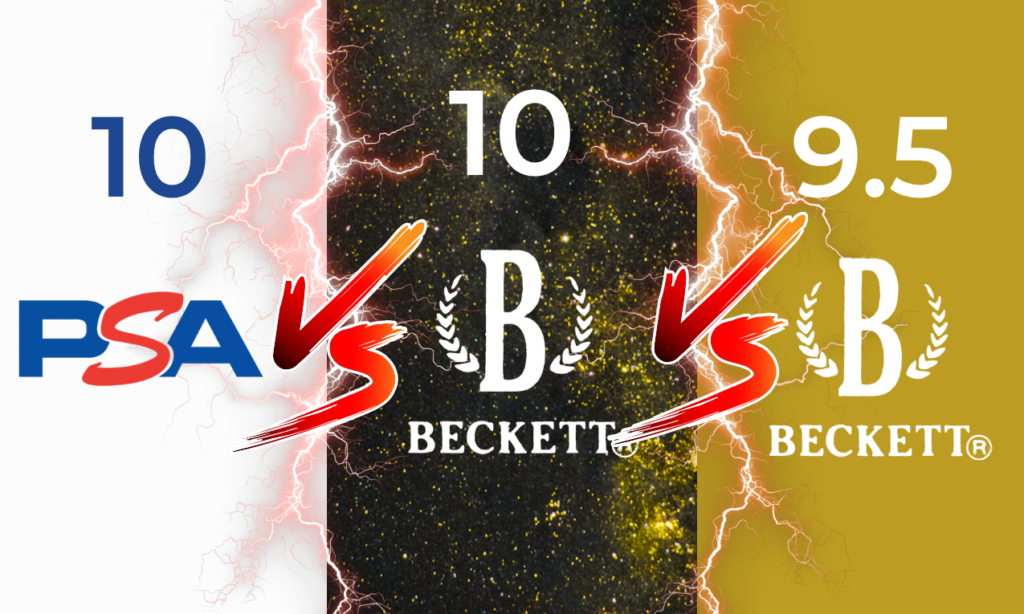
Walk into any online TCG community and you will find this argument happening on a daily basis, kinda…maybe… well, you can imagine it. Someone posts a freshly slabbed card, the comment section immediately splits, PSA 10 is king, BGS 9.5 is underrated, the Black Label is the only one that truly matters. Everyone has an opinion. Very few people are backing their opinion with actual numbers.
Here at The TCG Times, we live in the numbers (quick note: we are quickly climbing the ranks for #1 TCG X Finance website, so a big thank you, readers). So let us settle this properly, not with a preference, get your emotions out of here, but with a clear breakdown of what each grade actually returns, what it costs to achieve, and when each one is genuinely the right call for your portfolio.
Quick Definitions First (For the Newcomers)
Before we get into the money, let us make sure everyone is working from the same starting point.
PSA 10 Gem Mint: a grade from Professional Sports Authenticator (PSA), the world’s largest card grading company with approximately 72% of the overall grading market in 2025. A PSA 10 means the grader assessed the card as gem mint, centering within 55/45, four sharp corners, clean edges and surface. Crucially, PSA gives you one number. No breakdown of what got you there.
BGS 9.5 Gem Mint: a grade from Beckett Grading Services (BGS), and kind of the source of most of the confusion in this debate. BGS 9.5 sounds like it should sit just below PSA 10 in value. It often does not. The number means something slightly different than most people realise, and we will get to that.
BGS Black Label Pristine 10: the rarest grade in the hobby. Awarded by BGS only when a card receives a perfect 10 in every single one of its four individual sub-grades: centering, corners, edges, and surface. All four must be 10. One 9.5 anywhere on the card and the Black Label disappears. Fewer than 5% of all BGS submissions achieve it (a bit of scarcity, you know we love that $$$).
The Number That Catches Most People Off Guard
Here is the most important thing we can tell you about the BGS 9.5, and it is something a significant portion of the collector community gets wrong. We did the research.
A BGS 9.5 is not the BGS equivalent of a PSA 10. It is closer to a PSA 9.… We did the research.
Based on 2025-2026 sold listings from eBay and major auction houses, BGS 9.5 cards typically sell for 70-80% of the equivalent PSA 10 value. Not 90%. Not 95%. Seventy to eighty per cent… ugh. And when you look at crossover data, what happens when people submit a BGS 9.5 to PSA for regrading, only about 40% of BGS 9.5s cross over to PSA 10. The other 60% come back as PSA 9 or lower.
Why? Honestly, it’s because BGS is simply stricter. A card that achieves a PSA 10 with 55/45 centering would only receive a BGS 9.5 centering sub-grade, not a 10. The two scales measure the same physical characteristics, but BGS applies tighter tolerances at every tier. A BGS 9.5 represents a genuinely excellent card. It is just not the same standard as a PSA 10, which is why the market prices it accordingly. So do you crack the BGS 9.5 and run the gamble for a PSA 10… that’s totally on you.
Where the Black Label Stands (And It Stands Alone)
If BGS 9.5 underperforms relative to what most people expect, the Black Label is the opposite entirely.
On vintage cards: pre-1990 cards from the early eras of the hobby, a BGS Black Label consistently commands 115-140% of the equivalent PSA 10 price. Not a little more. More than double in many cases, big money! A card where PSA 10 sells for $1,000 USD might see its BGS Black Label equivalent trading at $1,150-$1,400 USD. On high-value vintage pieces, this premium can represent thousands of dollars on a single transaction.
The reason is straightforward once you think about it. To be honest, you probably know this part, Vintage cards are old, they were handled by kids, stored badly, traded without sleeves, and subjected to decades of wear before anyone thought to protect them, blah blah blah. A card from 1993 or 1999 that achieves a perfect 10 in all four sub-grade categories: centering that tight, corners that sharp, edges that clean, surface that pristine, after thirty years of existing is genuinely impressive. The Black Label on a vintage card is not just a grade. It is kind of like historical documentation that this specific piece of cardboard has somehow survived decades in perfect condition, and the scarcity of that outcome is reflected precisely in the price.
On modern cards, the Black Label premium is significantly more modest, typically 5-15% over PSA 10 (still solid on high-ticket cards) because modern printing technology produces cards with tighter, more consistent quality to begin with. A 2023 Scarlet & Violet card that achieves a Black Label is impressive, but it is not the same feat as a 1998 Base Set card achieving it. The market prices that difference accurately.
The Cost Equation: What You Are Actually Paying
Current 2026 pricing (confirmed April 2026, always verify current rates at beckett.com and psacard.com before submitting):
BGS: Base $14.95-$17.95 USD (75+ business days), Standard $34.95 USD (45 days), Express $79.95 (15 days), Priority $124.95 USD (5 days). No annual membership required.
PSA: Regular $79.99 USD (25 business days) is currently the cheapest widely available option, with Value tiers paused as of mid-2026. PSA’s $99 USD/year membership unlocks bulk pricing when Value tiers are active.
This cost gap matters significantly for portfolio maths, yes, math homie it not hard. PSA currently costs more than double BGS for a standard submission, which means the 10-20% resale premium PSA 10 commands over BGS 9.5 needs to be weighed against the significantly higher upfront cost to achieve it. For lower-value cards, the PSA premium rarely justifies the fee difference. For high-value cards, it often does. We would recommend, at a minimum, getting an app that looks over how your card would potentially grade instead of just going off your eye.
The Decision Framework: Which Grade for Which Card
Chase the BGS Black Label when: the card is genuinely vintage (pre-2000), passes your own close inspection as visually flawless under good lighting at multiple angles (get other opinions as well), and has a raw value high enough that the 115-140% premium on a successful outcome comfortably justifies the submission cost and the risk of not hitting it.
Chase PSA 10 when: maximum resale value and liquidity are somewhat a priority, the card is mid-to-high value, and you are not in a rush, seriously, it can take a longggg time. PSA’s has absolute market dominance (72% share), creating the most liquid market for general selling. Most buyers price primarily off PSA 10 values, which makes PSA 10 slabs the easiest to sell at the highest price.
Submit to BGS for a 9.5 when: you want the transparency of sub-grades to understand exactly what your card achieved and why, the cost difference matters to your portfolio maths, and you are comfortable that the resulting 70-80% of PSA 10 value still works in your favour after fees. But we would assume this is more something you would do with a card of sentimental value than maximising profits.
The hard truth about BGS 9.5: unless you specifically want the sub-grade detail for information purposes, or the card is a Black Label candidate that missed, a BGS 9.5 is generally not the optimal outcome for pure investment returns. It sits in an awkward middle position, more expensive to obtain than raw, but priced by the market closer to PSA 9 than PSA 10…like we said akwarddddd.
The TCG Times’ Verdict
For pure resale value: PSA 10 wins on most modern TCG cards. The premium is real, the liquidity is unmatched, and the market has spoken clearly with decades of pricing data. It really has become the standard for most modern prices.
For Black Label candidates on genuinely vintage, visually perfect cards: BGS wins! And it is not close…. The 115-140% premium over PSA 10 on the right vintage card is definitely the highest-returning grade outcome in the hobby.
For “budget-conscious” submissions on modern cards: BGS actually offers better value for money, lower fees, sub-grade transparency, and a 9.5 that still returns meaningful value over raw if the card is good enough.
Know which game you are playing before you submit. The grade that makes you the most money depends entirely on which card is in your hand.
Disclaimer: The TCG Times is a news and educational platform. All content provided is for informational purposes only and should not be construed as professional financial advice. Grading outcomes, resale values, and market conditions are subject to change. Always verify current grading company pricing before submitting. Past sales data is not indicative of future results.