There are two types of people in the TCG world. Those who saw a First Edition stamp as a kid, thought nothing of it, and then traded the card away for a holographic they liked better (yes, we did it and yes, we regret it). And those who held on (we envy you). The financial gap between those two groups is massive, in some cases, tens of thousands of dollars. Here at The TCG Times, we sit firmly in the camp of learning from that mistake and making sure it never happens again.
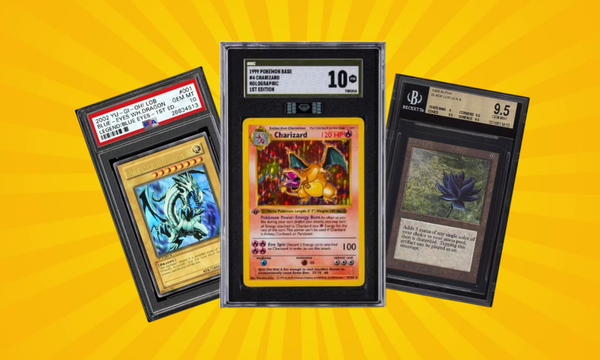
The “First Edition” concept is arguably the single most powerful value driver across all of TCG collecting. It surpasses game, era, and even condition to a degree (If you put it through the washing machine… we are sorry). Whether we are talking about a Pokémon Base Set booster box, a Magic: The Gathering Alpha pack, or a Legend of Blue-Eyes White Dragon 1st Edition Booster, the principle is identical, the cards produced in the first, limited print run of a set almost always become the most coveted, most expensive, and most historically significant pieces in that game’s entire catalogue. Understanding why is very important for every TCG investor.
What “First Edition” Actually Means Across TCGs
Before we get into the money side of things, it is worth clarifying what “First Edition” actually means, because it varies slightly depending on the game you play/collect/invest in.
In Pokémon, a First Edition stamp (a small “Edition 1” logo) was applied to the first print run of Base Set and selected sets during the Wizards of the Coast era. WOTC produced them in much smaller quantities than the Unlimited print runs that followed almost immediately, and the difference in market value between the two is, at this point, staggering.
In Magic: The Gathering, the equivalent is Alpha and Beta. Alpha was the very first print run of the original Limited Edition set in 1993 (probably before many of you reading this were even born), with approximately 2.6 million cards produced across the entire print run. Beta followed shortly after with a slightly larger quantity as most “second editions” usually do. Both are now considered the blue-chip assets of the entire MTG market, with some individual Alpha cards trading at prices that would make your eyes water, unless you held onto them, that’s probably tears of joy.
In Yu-Gi-Oh!, First Edition booster packs were produced alongside Unlimited printings from the very beginning of the game’s Western launch, with the 1st Edition stamp indicating that initial, smaller run. First Edition prints of key early cards from the original Legend of Blue Eyes White Dragon set command a serious premium, and rightly so.
Why Does a Stamp Change Everything?

The core driver is, as always, scarcity. The first print run of any product is almost always smaller than subsequent runs, because publishers are estimating demand rather than responding to it. There was no way for Wizards of the Coast to predict in 1998 that their new Pokémon card game would become a global cultural phenomenon (a multi-billion dollar business!). They printed conservatively. Then they scrambled to keep up, as stated, how would they know this would become the biggest card game ever! That early, conservative run is now frozen in time, a finite, non-replenishable supply. Boom that’s scarcity baby!
But scarcity alone doesn’t explain the full premium. There’s more to the story then a super limited print run. A First Edition card isn’t just hard to get, it is from the beginning. It carries the story of when this hobby was born, before the hype cycles, before the social media buyouts (then insane resale prices), before the world had any idea what these pieces of cardboard would eventually become investment assets. For collectors in their late 20s and 30s re-entering the hobby, a 1st Edition Base Set Charizard isn’t just an asset. It’s the dream they had as a little kid. That emotional connection is a value driver that doesn’t depreciate, and for a whole generation, that’s a lot of people chasing the same dream. And that’s leaving out the new kids on the block who want the card for investment or braging rights.
We touched on the extraordinary power of this when we covered The Legend of the Kabuto King a story that, at its core, is really about what happens when genuine scarcity (with a touch of genius in there) meets a compelling narrative, even on a humble First Edition common. If a common First Edition card can command that kind of market attention, imagine what the chase rares from those same early sets are capable of.
The Grading Premium: First Editions and Condition
For the investors among us, First Edition cards and professional grading are a natural pairing. A raw First Edition Charizard is worth a significant amount (a sh*t ton). A PSA 10 First Edition Charizard is worth life-changing money (a shi* ton x100). The grading premium on First Edition cards is, proportionally, higher than on almost any other category in the hobby. The reason is straightforward, the market understands that these cards are old. They were handled by kids, stored in shoeboxes, shuffled into decks without sleeves and rubber-banded to keep them together (I doubt we will ever see this again, OGs will understand), and subjected to twenty-plus years of wear before anyone thought to protect them. Most of us had never even heard of a penny sleeve. A high-grade example is genuinely rare in every sense of the word.
If you are sitting on any First Edition cards (lucky you) from early sets and haven’t had them professionally assessed, that is absolutely worth looking into. For a deeper breakdown of why grading is such a powerful value multiplier for investment-grade cards, and why not all grading companies are created equal. Our piece on The BGS Black Label explains exactly why condition at the top end of the market is everything.
The Reprint Problem (And Why It Doesn’t Apply Here & Never Will)
One of the most legitimate concerns in TCG investing is reprint risk (an investor’s nightmare and collectors’ dream), the idea that a publisher can significantly erode the value of a card overnight by flooding the market with new copies. This is a very real threat for modern cards, and it is a conversation worth having another day. However, original First Edition and Alpha/Beta cards exist in a protected category. We will never see a “reprint” of a 1993 Alpha Black Lotus with the original stamp and cardstock (wouldn’t be 1st edition otherwise). Konami cannot reproduce a genuine 1st Edition LOB Blue-Eyes with the original print quality and era feel. The original first run cards are permanently first run…, irreversibly scarce. Reprints, no matter how many come out, cannot dilute what already exists.
This makes First Edition originals arguably the closest thing the TCG market has to a truly non-dilutable asset class. That is not something we say lightly.
The TCG Times’ Verdict: First Is (Almost) Always Best
For investors, our position here at The TCG Times is clear. If you are building a long-term TCG portfolio and you have the capital to acquire genuine First Edition or Alpha/Beta pieces from the major games, those assets represent the most historically stable, narratively compelling, and scarcity-backed holdings in the entire hobby (this is a FACT!). They are not immune to market cycles, nothing is (sometimes it’s just not cool or wanted), but their floor is fundamentally higher, and their ceiling has proven, time and again, to be extraordinary.
If you are a newer collector and First Edition originals are currently out of reach, that is completely fine and absolutely no reason to feel disheartened (they are out of reach for most). Start by understanding what you are building towards, and let that knowledge inform your purchase decisions between now and then. The stamp is small. The difference it makes is HUGE!
Disclaimer: The TCG Times is a news and educational platform. All content provided is for informational purposes only and should not be construed as professional financial advice. Trading cards are high-risk, volatile assets. Past performance is not indicative of future results. Always perform your own due diligence before making any financial decisions.