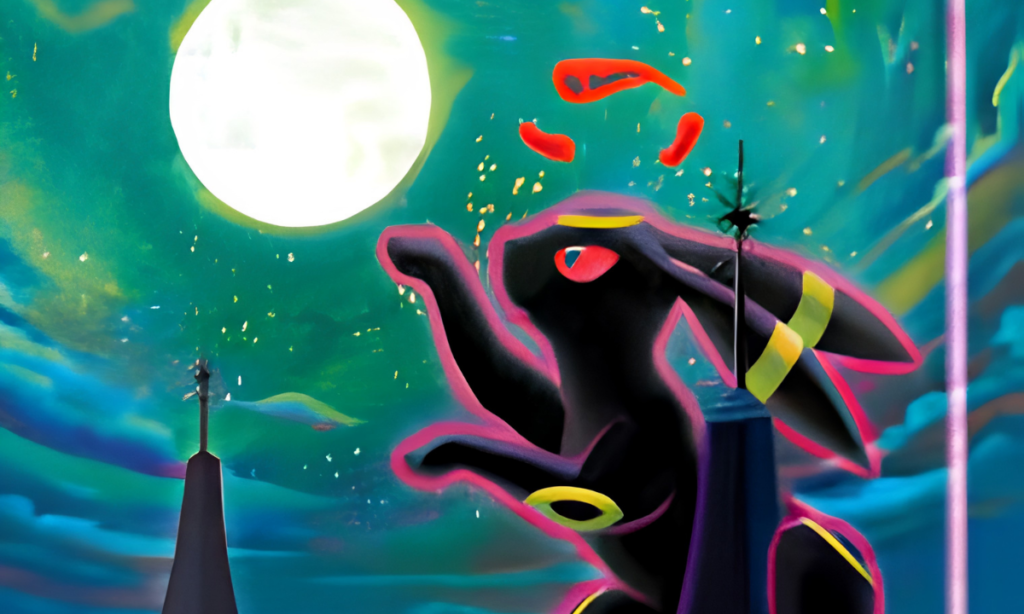
Here is a number that should terrify any chase card investor: Evolving Skies, released in August 2021, contains over 30 different alternate art secret rares, with each one appearing at a rate of roughly 1 in every 400 to 500 booster packs (if it doesn’t scare you keep reading…). That set has been opened, by some estimates, in the millions of packs since release. By any conventional investment logic, the chase card from that set should have been crushed under the weight of its own supply years ago (to simplify is should be cheap as chips mate). Instead, the Umbreon VMAX alternate art, universally known by its nickname, “Moonbreon” currently trades for somewhere between $1,500 and $2,100, depending on the week you check, with PSA 10 copies pushing toward $4,000. It has not just held value. It has become, by most measures, the single most valuable modern Pokémon card in the hobby.
This should not have happened, usually lots of prints = cheap prices. And here at The TCG Times, we think the reason it did happen is one of the most genuinely useful lessons in chase card investing available anywhere in the hobby right now.
The Setup: A Textbook Overprinting Risk
Let’s be clear about what Moonbreon was up against. Evolving Skies was not a limited print run. It was a mainline Sword & Shield expansion that stayed in print for an extended period, sold through normal retail and distribution channels worldwide, and was opened at a scale most special sets never come close to. Every single factor that typically tanks a chase card’s value over time, high print volume, an extended availability window, a hype cycle that eventually cools, all of this applied directly to this card.
And for a moment, it looked like the script was playing out as expected. After the initial 2021 launch frenzy, where raw copies briefly spiked above $500 on the back of mainstream attention from figures like Logan Paul, the broader Pokémon market underwent a well-documented correction. The card pulled back to the $250-$350 range through 2022 and into 2023 (don’t we all wish we purchased then..) a roughly 40-50% drawdown from its peak. If you bought at the top, that was a genuinely painful position to be sitting in… at the time.
The Recovery Nobody Expected
Here is where the story diverges from the typical chase card arc, an arc that the Cell Saga can’t even compete with. Rather than continuing to bleed value as more copies entered circulation, Moonbreon found a floor and began climbing again. By 2025, it was trading consistently above $1,000. By early 2026, it had pushed past $1,700. The card did not just recover from its correction… it surpassed its original hype-driven peak by several multiples, while the broader supply of opened copies continued to grow throughout that entire window, this really didn’t make much sense.
To put this in context, look at the rest of its own set. Rayquaza VMAX alternate art, the second most valuable chase card from the same set with a similar pull rate, currently sits in the $700-$850 range, still a strong result in its own right, but a fraction of Umbreon’s number. Sylveon, Glaceon, and Leafeon VMAX alternate arts, despite featuring equally beloved Pokémon from the same beloved mechanic in the same set, trade in the $250-$400 range, again not to bad. Same print run. Same pull rate. Same release window. Wildly different outcomes.
What Actually Separated Moonbreon From the Pack
If overprinting alone determined value, all of these cards would have converged to similar numbers by now. They definitely have not, and the gap tells us something important about what actually drives long-term chase card value beyond raw scarcity.
Artistic pedigree mattered enormously. The card was illustrated by Mitsuhiro Arita, the same artist behind the original Base Set Charizard, one of the most recognised names in the entire history of the TCG. That connection to the hobby’s most iconic card gave Moonbreon a narrative hook that no other card in the set could claim, regardless of pull rate.
Character popularity created a demand floor that scarcity alone cannot replicate. Umbreon has consistently ranked among the most popular Pokémon in fan polls for years. It’s now from the “older” generations and that fandom translates directly into sustained buying pressure that does not fade when the broader hype cycle cools, the way it did for less iconic Eeveelutions from the same set. Kind of similar to the classic 151 being usually hot picks.
The composition itself became iconic. Moonbreon’s rooftop-under-moonlight scene achieved something rare for a modern card: it became instantly recognisable even to people outside the hobby. That kind of crossover visual recognition is exceptionally difficult to manufacture and, when it happens organically, tends to be durable.
This combination is close to what we have previously referred to as the four pillars of card value: rarity, playability, nostalgia, and aesthetics. Moonbreon’s pull rate alone only delivers the first pillar, and a pretty weak version of it at that. It is the other three, nostalgia through the artist connection, aesthetic uniqueness through the composition, and genuine character demand, playability isn’t as heavy a focus in Pokémon as it is in MTG or Yu-Gi-Oh, but let’s be real if you’re reading this, chances are you don’t have a Moonbreon in your deck.
The Lesson for Your Own Portfolio
The takeaway here is not “overprinting doesn’t matter.” It absolutely still does, its destroyed prices of other cards in the past and for the vast majority of heavily printed chase cards, the standard playbook holds: high supply erodes long-term value, and we have covered the mechanics of that risk extensively in our piece on the reprints trap, although about Yu-Gi-Oh the main message still stands. Moonbreon is the exception that proves the rule, not evidence against it.
The actual, applicable lesson is this: when you are evaluating a modern chase card and weighing whether its current hype will survive years of continued printing and circulation, pull rate is only one variable in the equation. Ask whether the card has something beyond scarcity working in its favour, a connection to the hobby’s history, a Pokémon or character with genuinely durable popularity, or artwork distinctive enough to become iconic in its own right (that last ones tricky as you need the heard to like it as well). Cards with all three are exceedingly rare. When you find one, the overprinting risk that would sink almost any other modern chase card may simply not apply.
The TCG Times’ Verdict: Scarcity Is the Floor, Not the Ceiling
Moonbreon’s trajectory should reframe how we all think about chase card risk going forward. Supply concerns are real and should absolutely factor into your buying decisions. But the cards that ultimately defy those concerns and become genuinely generational holds are rarely the scarcest ones in their set. They are the ones that layer genuine demand drivers on top of whatever scarcity they have. Look for that combination before you chase the next “Moonbreon,” because the next one almost certainly will not look like the obvious choice on release day.
Disclaimer: The TCG Times is a news and educational platform. All content provided is for informational purposes only and should not be construed as professional financial advice. Trading cards are high-risk, volatile assets. Past performance is not indicative of future results. Always perform your own due diligence before making any financial decisions.