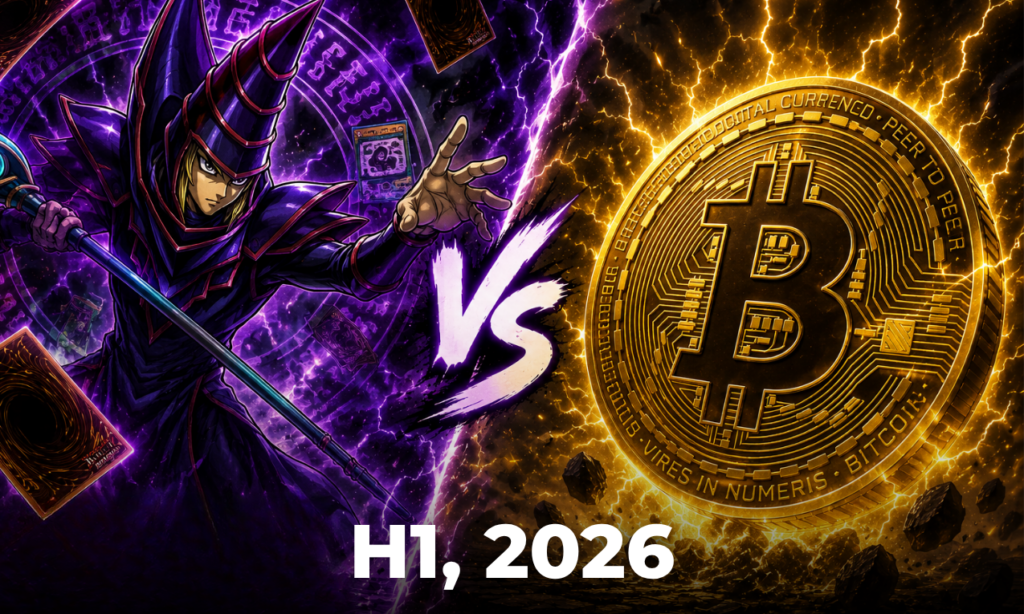
Bitcoin investors had a rough first half of 2026 (Calm down, bitcoin boys, it’s not a shot, just a rough H1). We are going to say that upfront, because it is the context that makes every TCG comparison in this series genuinely interesting rather than just a fun exercise. Bitcoin opened 2026 at around $97,000, peaked in enthusiasm, and then spent most of the first six months heading in the wrong direction, arriving at June 30 at approximately $58,503. That is a -40% return for H1 2026. Ouch.
The question we are asking today is whether Yu-Gi-Oh investors did any better. And the honest answer, in true Yu-Gi-Oh fashion, is: it depends which cards you were holding. Welcome to the most nuanced TCG in our comparison series. We promise it’ll be easier to understand than the actual card game!
Why Yu-Gi-Oh Is Not One Market, It Is Three
If you are new to Yu-Gi-Oh as an investment (and if you are, welcome, glad to have ya here), the most important thing to understand is that this game has roughly three different economies running side by side, and they perform very differently from each other…. because of course they do, but honestly it’s simple to understand.
The top rarity economy: Starlight Rares, Quarter Century Secret Rares (QCSR), and Platinum Secret Rares. Think of these as the high-end (blue chip), limited-edition versions of cards. Konami (the company that makes Yu-Gi-Oh) is structurally reluctant to reprint these treatments, which gives them a degree of scarcity protection that lower rarity versions of the same card simply do not have.
The competitive staple economy: Cards that players need for their decks right now. These can spike fast and hard, but they are also directly in the crosshairs of Konami’s reprint policy, because every time a tournament staple gets expensive, Konami tends to make more of it available. Great for players, frustrating for investors.
The nostalgia economy: Our personal favourite across all TCGs, original era cards tied to characters from the early 2000s anime. Dark Magician, Blue-Eyes White Dragon, original Exodia pieces, all absolute BANGERS by the way. These are driven by collectors in their late 20s and 30s who grew up with the show and are now spending adult money on childhood memories. (According to our demographics…. that’s probably you reading this, don’t worry it’s also us writing it) Sound familiar? It is exactly what happened with Pokémon Base Set, and it is slowly beginning to happen here too.
How Each Economy Did Against Bitcoin’s -40%
Top rarity cards: comfortably beat Bitcoin. Paladins of Bonds and Unity (QCSR) moved from below $100 in late 2025 to above $240 by May 2026, that is more than a 140% gain on a single card while Bitcoin was falling. Multiple Starlight Rares and Quarter Century Secret Rares showed high double-digit appreciation through H1. If this was your collection/portfolio, you had a very different first half to the average Bitcoin holder.
Competitive staples: mixed at best. This is where the Yu-Gi-Oh market gets complicated and, honestly, a little painful to write about. Cards spike fast when a tournament result or new strategy puts them in demand. But Konami reprints them, often within months, and the price collapses. A card that gained 80% in week one of a new meta format might be back below its starting price by week twelve. Over the full H1, investors who were not actively trading around the reprint cycle likely saw returns that were flat to modestly positive, better than Bitcoin’s -40%, but not by as much as the gross price movement suggests. If you’re investing in Yu-Gi-Oh cards, you probably shouldn’t have a large percentage of your portfolio in this section.
Nostalgia cards: solid and growing. Multiple original era cards saw genuine buyout activity in March and April 2026, with Dark Magician variants in particular attracting the kind of collector-driven demand that does not evaporate when the next meta update drops. This is our favourite category in Yu-Gi-Oh right now for patient investors, and it significantly outperformed Bitcoin in H1.
The Reprint Problem… Again
We keep coming back to this because it keeps being relevant. Yu-Gi-Oh’s biggest structural difference from Bitcoin is not the volatility, both can move 40%+ in a short window, just in different directions. It is the reprint risk. Bitcoin cannot be reprinted, there for creates scarcity. A Konami structure deck can appear tomorrow and halve the value of a card that took years to appreciate. We covered this in full in our reprints trap piece, and it is the single most important thing to understand before putting serious money into Yu-Gi-Oh singles.
The top rarity tier is your best protection against this. A QCSR or Starlight Rare version of a card can still be reprinted at a lower rarity but…. the specific premium treatment is much harder for Konami to justify cheapening. It is not perfect protection, but it is meaningfully better than holding mid-rarity staples and hoping for the best.
The TCG Times’ Verdict: H1 2026
If you held the right Yu-Gi-Oh cards, you beat Bitcoin’s -40% H1 2026 return very comfortably, and in the top rarity and nostalgia segments specifically, you beat it by a VERY WIDE margin. If you held mid-rarity competitive staples without actively managing the reprint cycle, the picture is murkier, but better than Bitcoin’s result, but not as dramatically better as the gross price movements might suggest once fees and reprint corrections are factored in.
The Chaos Origins set released July 3, 2026, right at the start of H2, bringing new support for multiple archetypes that were quietly appreciating through Q2 in anticipation. If you are holding relevant cards from those archetypes, the H2 window may already be open. Check out our Yu-Gi-Oh Collection Value Estimator to see where your collection might be heading.
Disclaimer: The TCG Times is a news and educational platform. All content provided is for informational purposes only and should not be construed as professional financial advice. Trading cards and cryptocurrencies are both high-risk, volatile assets. Past performance is not indicative of future results. Always perform your own due diligence. Bitcoin price data sourced from Fortune and StatMuse.