
To slab or not to slab, that is the question, and it is one of the most common questions in this hobby. Even better, it is one of the most consistently poorly answered ones. Imagine you pull a card that looks clean and crisp, someone in a forum/reddit/facebook tells you to get it graded, and suddenly you are on the PSA website wondering whether this actually makes financial sense. Here at The TCG Times, we are going to give you the honest framework that most content on this topic skips, because the answer is not the same for every card, every budget, or every goal, and pretending otherwise is how people waste thousands on grading fees.
The Three Questions to Answer Before You Submit Anything!
Before a single dollar goes toward grading fees, ask yourself 3 questions first. The answers determine everything.
Question 1: What is this card worth right now, raw?
Look up recent sold listings on eBay and TCGPlayer for the exact card in ungraded condition. Not asking prices (not what you wish you could get), actual sold prices. This is your baseline. If you do not know this number, you cannot make an educated grading decision.
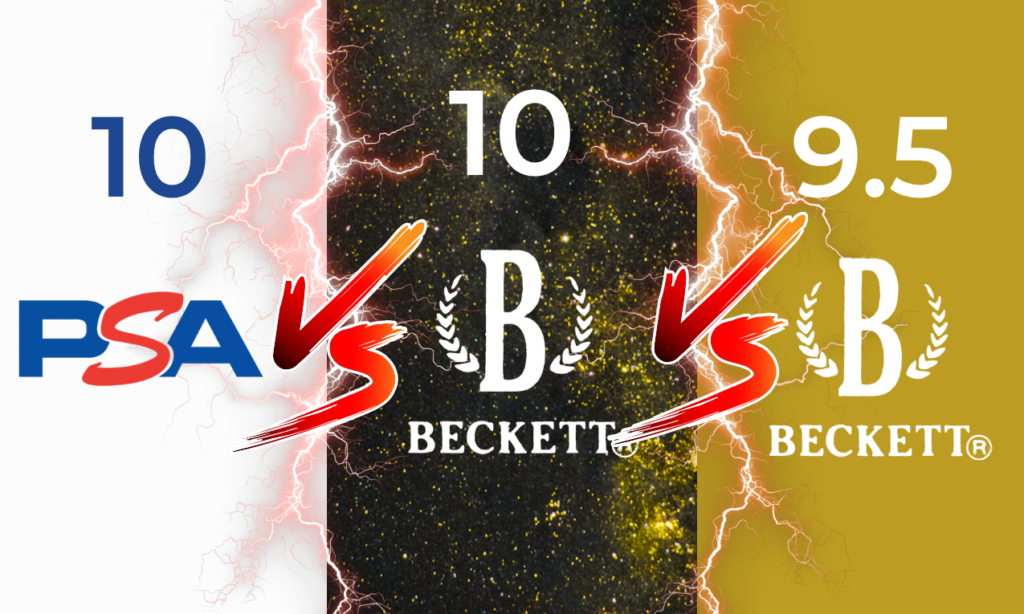
Question 2: What does a PSA 10 or BGS 9.5 of this card actually sell for?
Check PriceCharting, eBay sold listings filtered to graded copies, or recently completed auctions. The gap between this number and your raw value is your maximum possible gain from grading, before fees.
Question 3: What will grading actually cost me (you), all in?
In 2026, the cheapest widely available options are CGC Economy at approximately $15 USD per card and BGS Base at approximately $17.95 USD per card. PSA’s cheapest current option is Regular at $79.99 USD after Value tiers were paused in June 2026. And don’t forget to add shipping both ways, typically $15-30 USD, and your real all-in cost per card is between $30-110 USD depending on which company and service level you choose. Run the full number, not just the submission fee.
Once you have those three answers, the decision becomes straightforward maths rather than a gut feeling. Yeah we all hate maths, but when it comes to potential money in your back pocket, the 5min it takes to figure this out quickly becomes worth it.
The Value Thresholds That Actually Make Sense
Here is the framework we use at The TCG Times, based on the real fee structures and resale premiums documented in the current market:
Under $50 raw value: almost never worth grading for investment purposes. The grading fee represents too high a percentage of your expected return. Even in the very best case scenario, a perfect PSA 10, the net gain after fees rarely justifies the submission and shipping fees. The exception is if you have a 25-card minimum for CGC Bulk at $12 USD per card, which can make low-value submissions marginally viable as a batch. Or you just need a card or 2 to make it to the 25 card minimum.
$50-150 raw value: worth grading only if the card is acutally visually exceptional and the graded premium is documented. Do not send in a card you are “hoping will be good enough”. Run the numbers we mentioned previously. A card in this range can work in your favour at CGC Economy or BGS Base fees, if a PSA 10 or gem mint equivalent sells at 2x or more the raw price. If the graded premium is only 30-40% above raw, the maths rarely works after fees and eBay’s 12-15% selling cut. Something that often gets forgotten about in the hype of looking a potentional value.
$150-500 raw value: this is where grading starts making clear financial sense. At this value, even a BGS Standard or PSA Regular fee is proportionally reasonable, and a gem mint grade genuinely could skyrocket the card’s resale value. If your card in this range looks immaculate under close inspection, submission is well worth considering. As we always mention, get a second or third person to have a look and get their thoughts before grading.
$500+ raw value: grading is almost always the right call for investment-grade cards. The absolute graded premium on high-value vintage or chase cards can be thousands and thousands of dollars, making any submission fee look like a joke. Our full BGS ROI breakdown walks through the specific scenarios at this value level in detail.
The Condition Question: Be Honest With Yourself… Seriously
The single most expensive mistake in grading is submitting a card you “hope” grades well rather than one you know is exceptional. Every collector has experienced the disappointment of expecting a 10 and getting an 8, it is honestly a lesson we all have to go through at some point. That disappointment costs money in fees, time, and the now-awkward position of owning a graded card that did not hit the value you planned for, and you have either lost money or can’t find a buyer…
Before submitting anything, inspect the card under a bright, angled light source, not overhead light, but light coming in from the side, which catches surface scratches, haze, and edge wear that are invisible under normal lighting. Look at all four corners under magnification if you can. Check the centering against the border, hold a ruler to it if necessary. If you find yourself in doubt at any point, the card is probably not a gem mint candidate. And as stated previously, get a second or third opinion, going with your gut isn’t always the right option. And lastly download a pre-grading app, this will give you an unbiased idea of how good your card is.
The rule we follow: if you cannot look at a card under proper lighting and say with genuine confidence “this is a 9.5 or better,” do not submit it. A BGS 8 or PSA 9 on a card you paid $80 USD to grade is an expensive lesson, especially for people outside the USA. The cards worth submitting are the ones where your honest inspection says “this is exceptional”, not “this might be okay.”
Vintage vs Modern: Different Rules Apply
The slab game changes significantly depending on whether you are grading vintage cards (broadly, anything pre-2003) or modern product.
Modern cards grade better and more consistently because printing technology has improved a lot over the last 30 years. Submission rates and gem mint hit rates on modern Pokémon and Yu-Gi-Oh cards are genuinely high, which is one reason CGC has built strong momentum in the TCG market, their clean, modern encapsulation and competitive pricing appeal to collectors submitting large batches of recent product. Plus they have a fairly competitive pricing structure.
Vintage cards grade harder but the premium for gem mint is dramatically higher. A PSA 10 First Edition Base Set card is extraordinarily rare because the cards are decades old and most surviving copies show age. Most vintage cards are in played-with condition because they really were played with…. how were we meant to know they would be worth thousands when we were kids. That rarity is exactly why the premium is so significant. If you genuinely have a vintage card in exceptional condition, the grading case is very strong, but the inspection process needs to be even more rigorous, because the consequence of a lower-than-expected grade on a $300+ vintage card is more painful than on a $50 modern one.
The Goal Question: Investment vs Personal Collection
One final consideration that changes the decision entirely: why are you grading this card? Is it profit, bragging rights or juts keeping your collect safe.
If the answer is investment, you want to maximise resale value, you want to get every single dollar you can! The maths above applies in full. Optimise for the grade that returns the most money net of fees. Chase that bag homie!
If the answer is personal collection, you want to display and protect a card you love regardless of its graded value, then the financial ROI calculation matters less. Grading a card for personal preservation is a completely valid reason. Just be clear with yourself about which category you are in before you submit.
The TCG Times’ Verdict: Run the Numbers Every Single Time
There is no universal answer to “is my card worth grading?”, but there is always a specific answer for your specific card. Run the three questions above on every card before you submit. Check the all-in fee (all expenses together), check the graded premium price, and make the decision with maths rather than enthusiasm. Yeah, we know how lame that sounded, but it’s TRUE! The collectors/investors who consistently make money from grading are the ones who treat it as a calculated financial decision, not a lottery ticket on their favourite cards.
Disclaimer: The TCG Times is a news and educational platform. All content provided is for informational purposes only and should not be construed as professional financial advice. Grading fees, market values, and resale premiums are subject to change. Always verify current information before making financial decisions.