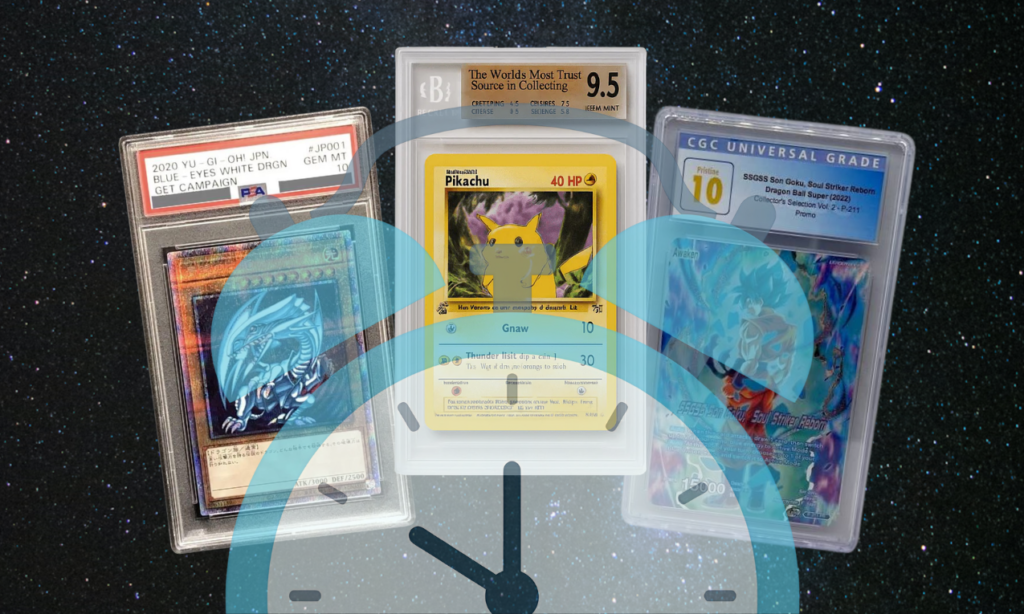
Grading your cards is not always the right call…. there we said it. We know that sounds strange coming from a publication that has written enthusiastically about the BGS Black Label and the premium that high-grade copies command over raw cards. But the grading decision is not binary, it is a timing and economic problem that looks different depending on the card, the market moment, and what you are actually trying to achieve, mixed in with personal preference. We have people here who will only purchase PSA 10s and others who only collect/buy raw. But lets break it down…
Getting this wrong costs money. Submitting too early locks up capital for months while grading turnaround grinds along. Submitting the wrong card means paying $30+ in fees plus shipping to create a graded copy worth less than the fee itself. And selling before you grade is sometimes the smartest move of all, despite feeling counterintuitive. Here is how we actually think about it.
Scenario One: Submit Now
The clearest case for immediate grading submission is a card that ticks all of the following boxes: it is visually immaculate on your own inspection (be honest with youself), it has a raw market value of at least $100-150 (making the grading fee a proportionally reasonable cost), and the graded premium over raw for a PSA 10 is documented and significant in the current market.
“Documented and significant” is doing a lot of work in that sentence, so let us be specific. For some cards, the PSA 10 commands 3-5x the raw price. For others, the graded premium is 30-40%, meaningful but not transformational. The difference matters enormously when you are weighing a $30-100 fee against your expected gain.
Check PriceCharting for completed PSA 10 sales versus raw sales on the specific card before you submit anything. If the graded premium does not justify the fee plus shipping plus the time value of your capital being locked up during turnaround, submission is not the right move yet. Do the research before making any moves.
The vintage card exception: older cards from the Wizards-era Pokémon sets, early Magic sets, and vintage Yu-Gi-Oh are almost always worth grading if they are in exceptional condition, because the survivor scarcity for high-grade copies of these cards is extreme, and the PSA 10 premium reflects it. A PSA 10 Base Set card is a completely different product from a raw copy in ways that go beyond a percentage premium, it is authentication, provenance, and condition guarantee rolled into one, and the market treats it accordingly.
Scenario Two: Hold Raw and Watch
Raw cards are not just “ungraded cards waiting to be submitted.” Holding raw is a deliberate strategic position, and there are good reasons to stay there.
The market is moving fast in your favour. If a card is in the middle of a price surge, whether driven by FOMO, a tournament result, or an announcement, the fastest exit is often raw, because graded copies require turnaround time you may not have before the peak passes. In a fast-moving market, raw liquidity beats graded quality for short-term plays.
You are not sure about the grade. This one sounds obvious but is routinely ignored, and probably the toughest part. If you cannot confidently look at a card under good lighting and a loupe (a small magnification tool, like a jeweller uses, yes this have almost become the norm) and say “this grades at least a 9,” the submission is a gamble. A PSA 8 on a card you expected a 10 is a painful, expensive outcome. Hold it, inspect it more carefully, and submit only when you are genuinely confident. We have a group of friends who use apps like Holodex to get a better idea if it’s worth submitting and have found good results so far.
The grading cost is disproportionate to the card’s value. If your card is worth $40 raw, paying $30-50 in fees to grade it makes no financial sense unless you have a VERY strong reason to believe a PSA 10 would push the value dramatically above that cost. In most cases at this value level, the math does not work. Hold raw, sell raw.
Scenario Three: Sell Before You Grade
This is the one that surprises most people, but it is genuinely the right call more often than most investors realise.
When a market is at or near a hype peak, grading is a liability rather than an asset. Turnaround times (the bane of existence for graderes), even at express service levels, are measured in weeks to months. If you hold through a grading cycle during a market correction, you may receive your graded card back into a market that values it significantly less than when you submitted. This actually happens fairly regularly. The grading premium does not protect you from market timing risk. It can actually amplify the damage if you are holding a graded card that now must be sold into a lower market.
The cleanest version of this scenario: you own a raw card that has surged in price due to a content creator, a tournament result, or a FOMO cycle, literally anything. The price is elevated, the fundamentals do not fully support the current valuation, and you have a decision to make. Selling raw at the hype peak and capturing the gain is often better than grading during the peak and selling months later into a correction. A 10% loss in graded premium is a better outcome than a 30% market correction while your card sat in a grading queue with everyone else that had the same idea.
There is also a category of card where grading simply does not add meaningful value to the transaction. Competitively relevant singles in Yu-Gi-Oh, for instance, are overwhelmingly bought by players who want to sleeve and use them (yes, people actually play the games) , not graded card collectors. Submitting these for grading removes them from the player market and often into a collector market that may not value them equally. Know your buyer before you decide on your product format and do your research.
The Turnaround Reality Check
A point that deserves its own paragraph, grading fees are only one part of the true cost of submitting, they are just the obvious cost at the start. Turnaround time is the other, and it is often underestimated!
Even at express or super express service levels, turnaround times from PSA, BGS, and CGC regularly exceed their stated estimates, particularly during high-volume periods. During the Pokémon boom of 2020-2021, some standard submissions took 12+ months to return, yes, over an entire year! Even in 2026 with improved infrastructure, 3-6 months for standard service is realistic. That is capital locked up for half a year, earning nothing, in one of the most volatile markets in existence. Factor this into every submission decision.
The TCG Times’ Verdict: Grade Strategically, Not Everything with Value
The reflex to immediately grade every valuable card you own is costing collectors/investors real money across this hobby. Not because grading is bad, it is a genuinely powerful value multiplier on the right cards at the right time. But treating it as a default rather than a strategic decision means paying fees, waiting months, and sometimes returning a card to a changed market plus the emotional damage of expecting a 10 and getting a 6. Think before you submit. Check the math. Know the market. And when in doubt, sometimes the best move is to sell raw, capture the gain, and redirect the capital to the next opportunity.
Disclaimer: The TCG Times is a news and educational platform. All content provided is for informational purposes only and should not be construed as professional financial advice. Trading cards are high-risk, volatile assets. Past performance is not indicative of future results. Always perform your own due diligence before making any financial decisions.