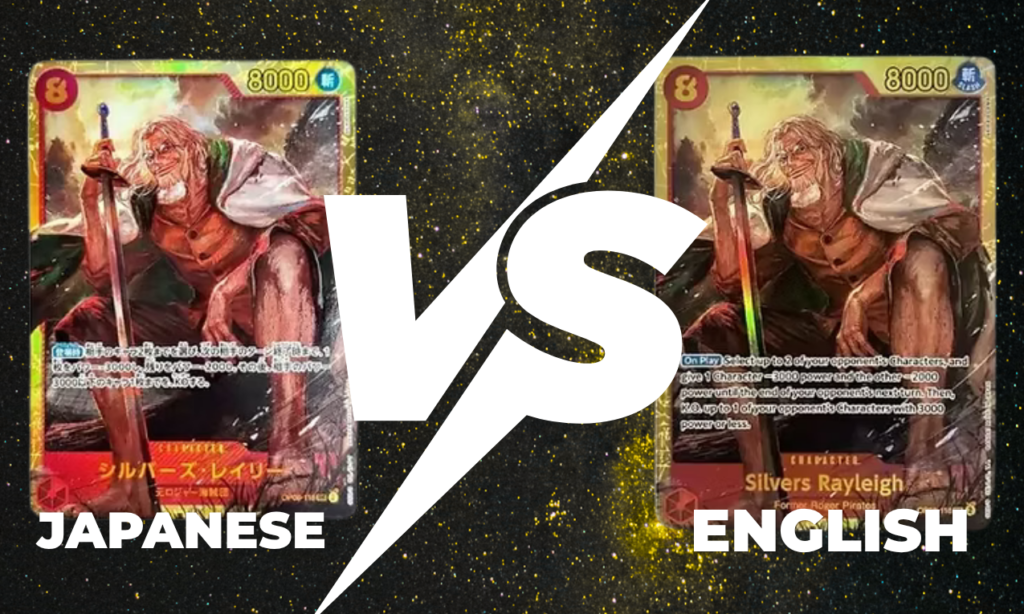
We have had this debate before, and it is a good one. When we covered Japanese vs English Pokémon investing, the answer was fairly clear… English for long term, “blue-chip” investment, Japanese for superior print quality, earlier trend signals, and some genuinely compelling exclusives. One Piece TCG scrambles that formula almost completely, and understanding why is one of the most useful things a new One Piece investor can get their head around before they start spending money. You need to know what you’re buying and why!
Because here, unlike in Pokémon, the Japanese version is not just a language preference. In One Piece, Japanese is often the investment.… let us explain.
Why One Piece Is Different From Every Other TCG Language Debate
In Pokémon, the English card market is larger (like a lot larger), more liquid, and more globally dominant. The investment case for English over Japanese is underpinned by a simple demographic reality… the English-speaking collector base dwarfs the Japanese one in terms of volume and secondary market activity.
One Piece flips this. The franchise itself is Japanese. Its fanbase is genuinely global, but the origin culture is Japanese, the manga and anime are consumed in Japanese first, and the collector community that has been deepest in this hobby from the very start (the most nostalgic), the community that was buying OP-01 at launch price and understands the IP at its deepest level, is largely Japanese or Japanese-market adjacent. This means the Japanese card market is not a niche subset of the broader One Piece TCG world. It is, in many respects, the primary market. Chill out, English One Piece fans, yes, you watched the non-dubbed show, but that doesn’t mean you were the primary market or make you Japanese.
The most important practical consequence of this: the highest-value cards in One Piece, the Manga Rares, the Gold Super Parallel, the top Special Parallels, exist in Japanese first and in some cases exist only in Japanese. The Gol D. Roger Gold Super Parallel (OP09-118), currently the most valuable card in the entire One Piece Card Game and trading at approximately $4,982 USD, is a Japanese-exclusive treatment. There is no English equivalent. The Gold Super Parallel format has never been applied to any other card in the game’s history, which means if you want it, you are buying Japanese, full stop. The Japanese market is not setting a premium over English on this card. It is the only market that exists for it, and that distinction tells you everything about where price discovery actually lives in this game.
The Three Cards That Define the Japanese Premium
There are three specific categories in One Piece where the Japanese version carries a meaningful, documented premium over English, and each one tells you something different about how to think about this market. We told you at the start it’s not as simple as Pokémon.
Manga Rare cards are the clearest example. These cards feature panel artwork directly from Eiichiro Oda’s original manga, rendered with exceptional care and in some cases with treatments that simply do not translate to English printings with the same visual impact. For long-term collector value, the Japanese Manga Rare is the reference version of the card, the one serious collectors compare and the one that commands the highest graded premiums.
Gold Super Parallel cards, at the moment, are currently unique to OP-09, The Gold Super Parallel treatment is Japanese-exclusive, the English printing of OP09-118 exists but only as a standard Secret Rare foil, not the GSP format and commands its premium accordingly.
Pre-global release Japanese exclusives. Until 2026, Bandai released Japanese sets three months before English equivalents. Early sets, OP-01 through OP-05, spent that initial window as Japanese-only products, and the first-to-market scarcity premium has proved durable on specific cards from those sets.
Where English Wins
This is not a one-sided argument, and we want to be direct about where English holds a genuine advantage.
Liquidity for the Western investor is significantly higher in English. If you are based in Australia, the US, the UK, or most of Europe, selling English One Piece cards on eBay, TCGPlayer, or through local card shops is faster and involves a smaller spread than selling Japanese equivalents to the same audience. The buyer pool for English cards in Western markets is simply larger and always will be, which matters if you ever need to exit a position quickly.
The simultaneous global release schedule from 2026 onwards has begun to narrow the Japanese premium on new sets by eliminating the first-mover scarcity that previously gave Japanese cards a head start. Going forward, sets from OP-14 and beyond will launch in both languages simultaneously, which means the Japanese-only early window advantage disappears on new product. This is a meaningful shift in the investment plans and one that genuinely tilts newer releases more toward English parity than older ones.
English PSA populations are growing rapidly as Western collectors grade at an increasing scale and growing inventory faster than ever, which builds the reference database and buyer confidence that makes English graded cards more liquid internationally.
Our Practical Framework: Which Language, Which Card, Which Timeframe
Rather than picking one language and applying it universally, here is how we actually think about it at The TCG Times:
For early sets (OP-01 to OP-05) and top-tier chase cards: Japanese, simple. The premium is documented, the collector prestige is there, and for Manga Rares and GSP cards specifically, Japanese is the reference version the market looks to for price discovery.
For sets from OP-14 onwards (simultaneous global releases): English becomes significantly more competitive, and for Western-based investors specifically, English offers better liquidity without sacrificing much of the premium that previously made Japanese the clear choice. As we expected to see, once the same time global releases happen, the English versions take over the market.
For graded cards at any price point: whichever language grades better on the specific copy you have. Bandai’s print quality is excellent across both, but individual card inspection should drive the grading decision rather than a blanket language preference.
The TCG Times’ Verdict: Know the Card Before You Pick the Language
In One Piece, the language question is inseparable from the specific card and timeframe (released date) in question, which is honestly more nuanced than most other TCGs, and reflects the unique position One Piece occupies as a Japanese-origin IP with genuinely global collector appeal. Do your research on the specific card first, not set the SPECFIFC CARD. Let the language follow from where the premium actually lives, not from a blanket preference applied before you have even looked at the numbers.
Disclaimer: The TCG Times is a news and educational platform. All content provided is for informational purposes only and should not be construed as professional financial advice. Trading cards are high-risk, volatile assets. Past performance is not indicative of future results. Always perform your own due diligence before making any financial decisions.