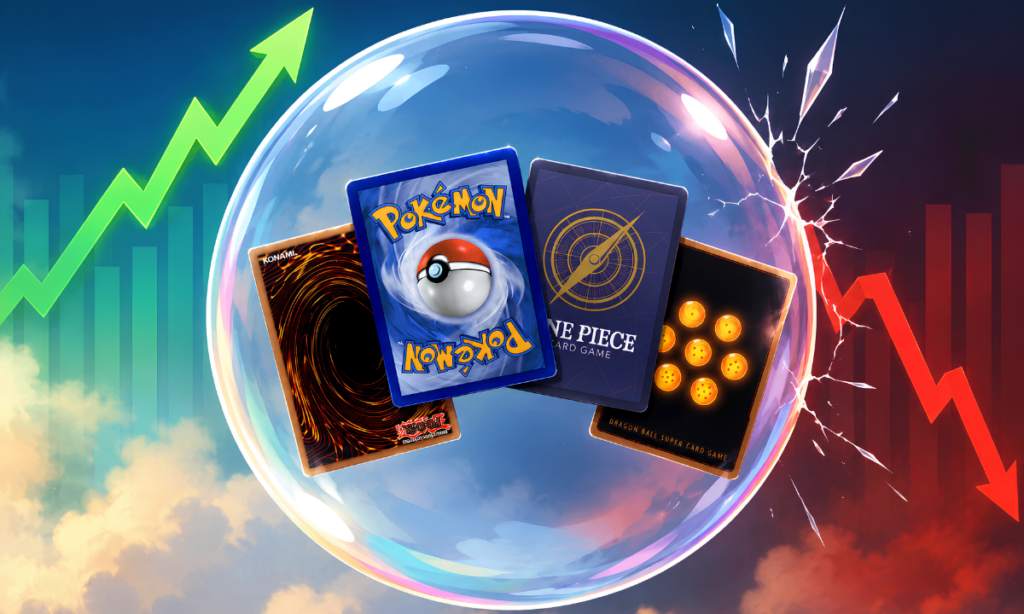
Every single time the Pokémon or Yu-Gi-Oh market (and some emerging TCGs) has a rough few months, prices correct. A set was over hyped and then underperforms, maybe even a reprint announcement destroys 40% of a high value card overnight. Then the same conversation starts up again… Forums, social channels, and YouTube videos flood in with people saying the bubble has finally popped, and those same people acting like anyone still investing in cardboard is an idiot who has wasted their time and lost their money. BUT we have heard this take about every six months for the past 5 years, and the people claiming the “bubble popped” are usually resellers who have been in the hobby for the last 5 minutes and are sitting on boxes they can’t sell.
We here at The TCG Times, we are going to give you our most direct answer to date… the bubble has not popped. And the reason most people think it has tells you a whole lot about the difference between reselling and investing.
The Reseller’s View vs The Investor’s View
If you have been in the TCG game for a while, you know what we are about to say. The people who loudly claim that the TCG bubble has burst are more than not the exact same people who got into the hobby expecting to flip cards for quick profit, then found out it actually takes some skill and background knowledge to make any money. Therefore, these same people have concluded to themselves that the opportunity to make money has gone. They are not wrong in the fact that their opportunity is gone… buying low, selling high, rinse and repeat has become far less reliable than it was in 2020-2021. The “easy money” phase of any real emerging asset market always ends BUT that is not the “bubble popping”, it is the opposite: the market has matured into a real asset class and not a get rich quick scheme.
To understand this, we need to break down the difference between a reseller and an investor. A reseller needs the market to consistently keep going up in the short term (days, weeks, a couple of months) on whatever TCG they just threw money at. An investor needs the market to be worth more in 3, 5, or even 10 years compared to where it is today. These are two completely different people playing completely different games. It’s easy to confuse them, and it’s why so many people convinced themselves the market was dead in 2022 while patient (and smart) holders were quietly sitting on assets that have doubled and quadrupled since then.
What the Data Actually Shows
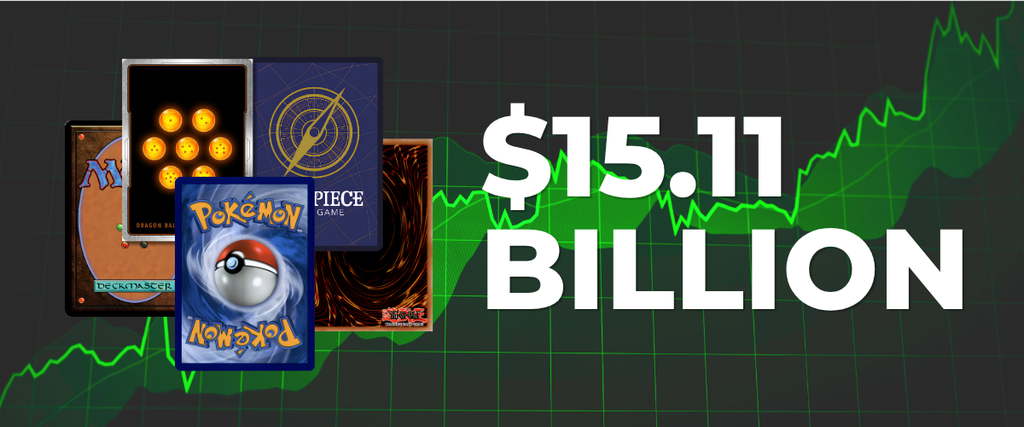
If you want to make some money in this game, you gotta look at the data! The global TCG market is worth around $15.11 billion USD in 2026 (otherwise known as a sh*t ton), and it’s still growing at over 10% per year. Look at Pokémon cards for exmaple, they have appreciated roughly 3,820+% since 2004 against the S&P 500’s 480+% over the same period. To be clear, that is cardboard absolutely dominating the stock market! The PWCC Top 500 Index, which tracks the top 500 trading cards across all TCGs has shown returns to be 94% higher than the S&P 500 over 10 years. And yet we have people saying the “bubbles popped” apparently…
We aren’t even cherry-picking these numbers from 2021 hype, when prices were artificially inflated because of pandemic era spending. These are up to date 2026 numbers, post the correction, after all the killer reprint cycles and after the “bubble burst” that was declared every six months. What this shows is the underlying trend is going up, not down. Not every card (or set), every single week is destined to climb to new heights, but looking at the big picture, the long-term trajectory of the market has continued to appreciate through every correction cycle.
Aside from just higher long-term returns and sales, we need to look at what’s happening around the card space. PSA has graded tens of millions of cards, more than ever before. Goldin Auctions has jumped in and started backing some of the biggest card auctions in the world. And honestly, something we never expected to see is the world’s first tokenised Pokémon card fund launching on the Hong Kong Stock Exchange in 2026. As we covered in our piece on whether TCG cards are a legitimate alternative asset class, the CEO of the world’s largest collectibles auction house went on CNBC and called trading cards an accepted alternative asset. That does not and would not happen in a market that is dying.
Corrections Are Not Crashes
Corrections and crashes are not interchangeable terms. We will use a real-world examples to explain: stock markets correct, Real estate markets correct, gold and minerals correct, and even oil corrects. Every mature asset class goes through times when prices drop significantly some 20, 30, or even 40% at times, before recovering and pushing to new highs. These are what real investors call corrections, and we understand them as normal, healthy parts of how all markets function over time.
So now you understand that the TCG market is maturing and works the same way, it just does it on specific cards and sets rather than across a broad index. A reprint announcement cuts a card’s value by 40% or a CEO gets caught in a scandal at a Coldplay concert (if you know you know) both affect the market, but neither market dies. What’s happening is simply a correction in a specific asset (or card) within their market. If a over hyped set underperforms and all the sealed product prices fall below RRP, that is a correction showing us the product was overvalued. None of these examples means the overall market is worthless or that the asset class is done for. They mean specific assets were overpriced, and the market corrected them. And to put it plainly, this is how markets are supposed to work.
The people who bought in at the insane peak of 2020-2021 pandemic mania and have not recovered yet are the ones experiencing the cost of bad timing, not the end of an entire asset class. You have to factor in the people who bought patiently in 2018 and 2019, held through the hype and the correction, and some are still holding, these are the peeps that are sitting on insane returns and aren’t really bothered about whether the bubble has “popped.”
The Real Risk That is Worth Talking About
Now let’s be real clear, we are not saying TCG investing is risk-free, that would be absurd and irresponsible and just incorrect. Every market has its own risks, and in the TCG game they are specific and mostly manageable. The reprint risk on individual cards, IP risk on newer and emerging franchises, fakes and counterfeits, and the general liquidity risk of trying to exit a large position quickly (trying to get rid of expensive product fast). These are real concerns that deserve attention and understanding. Even just being aware of this will give you an edge on your future TCG investments.
So what isn’t a risk? And that is the market ceasing to exist, or the entire concept that TCG investing will become invalid. The infrastructure surrounding TCGs is deep (think multiple million-dollar grading companies, TCG accessory companies, IP weights, etc). The collector base is too large, global, and accessible to pretty much anyone. Plus the generational nostalgia wave driving demand isn’t fading; it’s growing. The kids that love cards now will grow up, get real money, and the cycle will repeat.
The TCG Times’ Verdict: The Bubble Has Not Popped – It Has Grown Up
The TCG investment market in 2026 is looking a lot less like a bubble and more like a maturing asset class finding its footing. It’s growing like any other asset class, just with similar but it own slightly different hurdles compared to traditional assets, for example, hype cycles, corrections through reprints and market fatigue, but backed by a steadily rising floor and underpinned by scarcity, demand, and an infrastructure growing around it and building the TCG space as a whole. So we dismiss the overnight-profit resellers who boldly claimed that money in TCGs is dead, as they were never really investors to begin with. The patient holders who bought quality assets at reasonable prices and held them are doing exactly what smart investors in any other asset class do.
It’s really simple: the bubble hasn’t popped; it has just slowly made the “get rich schemes” void. Those are not the same thing.
Disclaimer: The TCG Times is a news and educational platform. All content provided is for informational purposes only and should not be construed as professional financial advice. Trading cards are high-risk, volatile assets. Past performance is not indicative of future results. Always perform your own due diligence before making financial decisions.