Disclosure: This post may contain affiliate links. If you make a purchase through one of these links, The TCG Times may earn a small commission at no extra cost to you.
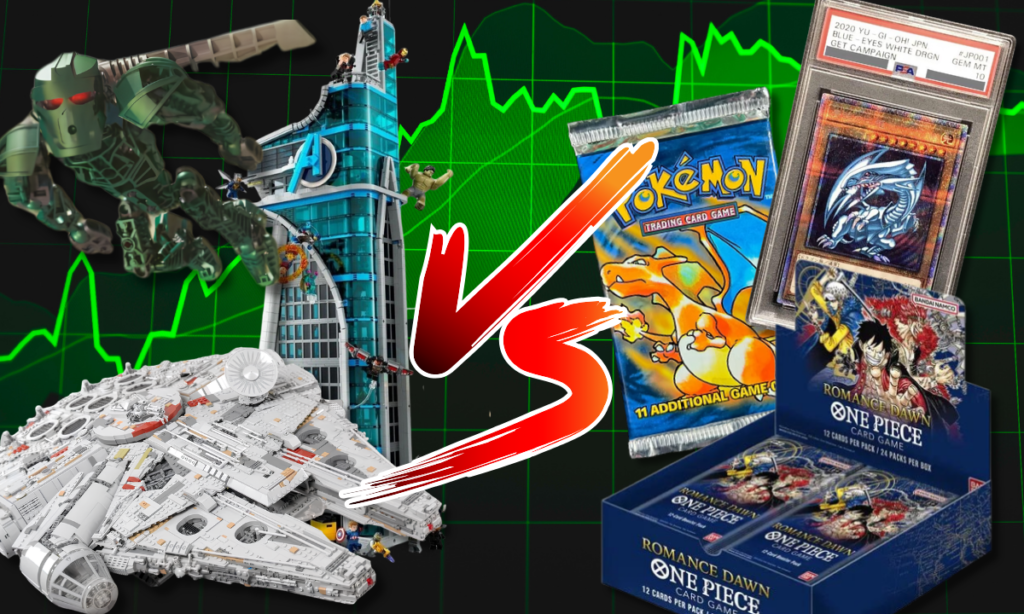
When it comes to Cards vs Capital, we have compared pretty much all of them: Pokémon cards vs the NASDAQ, One Piece cards vs Bitcoin, cards vs gold, cards vs sneakers, but this is the one that feels like it could be a family debate around the dinner table. Two groups of collectors/investors who are both fully convinced they have the upper hand over the other. Which is the better investment, the plastic bricks or their cardboard with pictures? Here at The TCG Times, we are not here to pick sides, we really do love both as an investment and just in general, but what we are here to do is run the numbers.
The LEGO Investment Case Is More Real Than Most People Expect
We want to start off by giving our respects to LEGO before we get competitive, because the data deserves it. Back in 2021 a study was done by the Higher School of Economics in Moscow that analysed more than 2,300 retired LEGO sets sold between 1987 and 2015, what they found was an average annual return of 11% per year, not bad at all considering it outperformed the S&P 500 (10.5% nominal), gold (9.5%), and bonds (4%) over the exact same period. We should also quickly mention The Sharpe ratio, which measures return relative to the volatility of an asset, this also favoured LEGO compared to the major asset classes mentioned before.
So we just spat a bunch of numbers at you, but what does it really mean? Buying the right retired LEGO sealed set and holding it for five to ten years has on average, been what most would call a fairly strong investment. This isn’t just a “lucky one-off”, it is an average across thousands of sets that spans over nearly three decades.
Keep in mind, though, not all sets have the same investment potential, the big winners are almost always large licensed sets with iconic IP, UCS Star Wars, Modular Buildings and the Harry Potter flagship sets. These have delivered 200-500% appreciation on specific sets. The Millennium Falcon (75192), released in September 2017, retailed at $849 USD and currently trades at $1,100-1,200 USD sealed in 2026. The Rivendell (10316), released in March 2023, retailed at $499 USD and is already at $650+ USD ahead of schedule. Around retirement (when LEGO stops making the set), sets appreciate at around 35% in their first year on average, which sounds kinda small until you realise smart investors are buying key sets all year round and watching most of them constantly go up and up and up.
Where LEGO and TCG Cards Are Similar
TCG and LEGO investment concepts are actually closer than you would assume.
Both reward buying at retail before the market reprices: Yes it seems obvious, but we have to mention it. The LEGO investor buying a retiring set at MSRP and the TCG investor buying sealed product before a hype cycle are playing the exact same game with the same plan, they are just getting in early.
Both are driven by IP weight and nostalgia: We love the nostalgia element, as it’s a huge factor. Here’s what you may not expect, LEGO outperforms this key factor because the IP is is borader and more diverse, therefore being generationally beloved by pretty much all ages (there’s something for everyone). This is not to say Pokemon, Yu-Gi-Oh or One Piece, or any other TCG, doesn’t have nostalgia; they definitely do, but LEGO can collaborate with almost any IP even those TCGs we just mentioned.
Both require storage and condition management: LEGO might be plastic, but a cardboard box in a damp garage still depreciates. A raw Pokémon card without a sleeve does the same. Both require some hands-on and smart storage conditions.
Where TCG Cards Win
Here is where the comparison tilts in favour of the cardboard gang.
The ceiling is dramatically higher in TCGs: As mentioned before, LEGO’s 11% average annual return is pretty darn solid butttttt….Pokémon cards have appreciated 3,820+% since 2004 against the S&P 500’s 480+% over the same period, and that’s just the beginning…. An Alpha Black Lotus from MTG sold for $3,000,000 USD, a PSA 10 First Edition Charizard surpassed $500,000 USD, an OP-01 booster box went from $100 USD to $4,344 USD in only three and a half years! This is by far TCGs biggest upside in this comparison.
Grading adds a value layer LEGO does not have (currently): If you grade any card to PSA 10, you have instantly created an authenticated product with a guaranteed condition that can now be sold at a premium over raw copies. LEGO has no equivalent (at the time of writing this), an unopened and ungraded box is the stock standard, and condition is opinion-based. TCG investors can extract/create additional value from the original product that LEGO investors simply cannot.
The IP risk is lower in major TCGs: LEGO’s investment in licensed IPs can create a vulnerability, for exmaple if LEGO loses or decides to end a licence, the associated sets often collapse in value (usually). Look at the TMNT LEGO, when it lost its licence, it affected set prices directly. Or another example is minifigs tied to a controversial celebrity that have spiked and crashed based on news events. Pokémon, Yu-Gi-Oh, MTG, and One Piece are independent IPs without this third-party licensing risk at the core of the investment. Charizard can’t get drunk and do something controversial and wake up on TMZ embarrassed the next day.
Where LEGO Wins
Accessibility and simplicity: We are talking in general terms here, you do not need to understand pull rates, grading tiers, pop reports, etc to buy a retiring LEGO set at retail and hold it and thank bank some cash in a years time. The 35% first-year appreciation average on a set that you know is stopping being manufactured is a very low-friction strategy compared to the research you need to do to feel confident in a TCG investment.
No reprint risk equivalent: LEGO doesn’t “reprint” a retired set in the way Konami can (and does) reprint a Yu-Gi-Oh set/card. The closest thing to a reprint LEGO has is re-releasing a set in a new version but pretty much all LEGO sets are on a MTG like Reserved List, it keeps the product rare once the retirement is announced and does not dilute the original in the way a card reprint does.
The mid-tier market is more forgiving: We all know in the TCG world the wrong modern card at the wrong time can lose 40-60% value in a day after a reprint announcement. LEGO sets, even the mid-tier ones, hold value near original retail on retirement and appreciate modestly.
The TCG Times’ Verdict: Cards for Upside, LEGO for Simplicity
For maximum investment upside (on the right assets), TCG cards win this comparison and it is not close at the top end. The grading opportunities, the reliable IP stability of major franchises, and the very well documented long-term appreciation of vintage assets (which are growing as more cards become “vintage”) give the best TCG holdings a ceiling that no LEGO set has matched to date.
For accessible, relatively low-research alternative investing with a very reliable track record and fairly low risk, LEGO is super compelling. For investors who want exposure in the collectibles space without the need for hours and hours of research that TCG investing rewards, it is honestly a solid and safer option..
In our opinion… Honestly? If your garage can handle both, run a little of each and diversify, it makes sense.
Disclaimer: The TCG Times is a news and educational platform. All content provided is for informational purposes only and should not be construed as professional financial advice. All assets referenced are high-risk and volatile. Past performance is not indicative of future results. Always perform your own due diligence before making financial decisions. LEGO return data sourced from the Higher School of Economics Moscow 2021 study and BrickLens 2026 analysis.