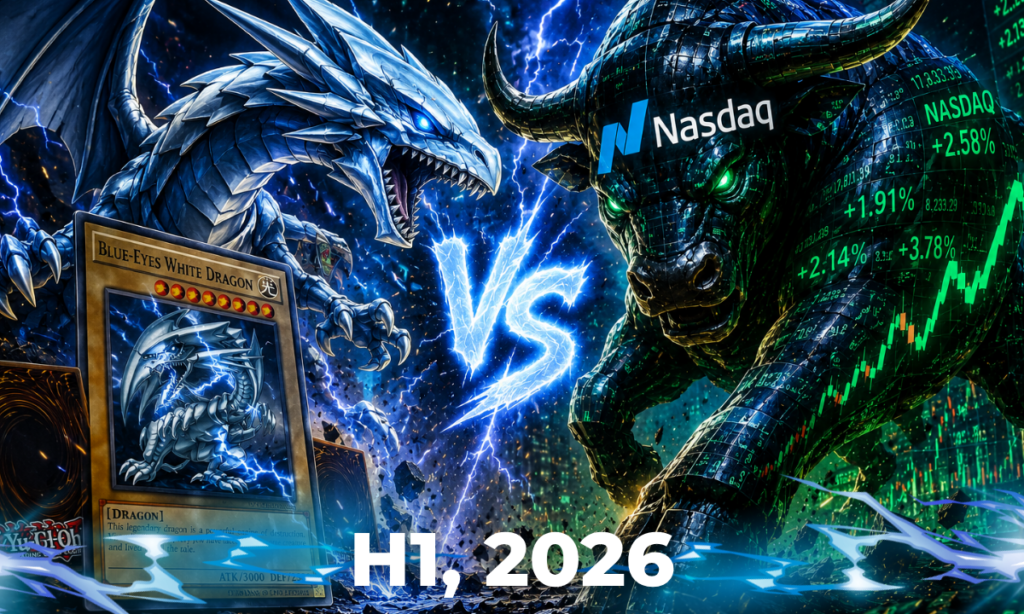
Welcome to the second instalment in our H1 2026 (the first half of the year for the new peeps) TCG franchisee vs the NASDAQ 100 series, this one’s for the Yu-Gi-Oh gang, where we put each major TCG head-to-head against the NASDAQ 100 for the first six months of the year. This one is the most nuanced of the four, and we are going to be direct about why the Yu-Gi-Oh market does not behave like a single, unified asset class. Kind of like how Yugi doesn’t play by the game’s rules in the show… It behaves like several different markets sharing the same card backs, and the gap between its best-performing segment and its worst-performing one in H1 2026 is significant enough that an honest answer to “did Yu-Gi-Oh beat the NASDAQ?” almost entirely depends on which Yu-Gi-Oh you were holding or are investing in. More on that shortly.
The benchmark: NASDAQ 100 returned +17.92% in H1 2026, as of June 29. That is the number to beat, and as we said in our Pokémon piece, that is genuinely a strong result by historical standards, not a low bar to clear.
The Yu-Gi-Oh Market in H1 2026: A Tale of Two Segments
Let us start with the segment that won, clearly.
Top rarity cards, Starlight Rares, Quarter Century Secret Rares (QCSR), and Platinum Secret Rares had a strong first half. If you are new here, think of these as the premium, limited-edition versions of cards that Konami (the company that makes Yu-Gi-Oh) is structurally reluctant to reprint or flood the market with. They are the safest category in Yu-Gi-Oh for investor purposes, and H1 2026 backed that up with real numbers. If you’re not a big TCG investor, rare cards = bigger money.
Specific examples, Paladins of Bonds and Unity (QCSR) moved from below $100 in late 2025 to listings above $240 by May 2026. Varudras the Final Brimstone King saw double-digit appreciation driven by incoming card support. The Starlight Rare Fallen of the White Dragon rebounded sharply from May onward. Quarter Century Secret Rare Phantom Knight cards climbed ahead of the Chaos Origins release. Cards in this top rarity tier that were well-positioned going into 2026 broadly matched or exceeded the NASDAQ 100’s 17.92% return across the half. Good news for those holding the good stuff.
Now the segment that did not do well…
Mid-rarity competitive staples continued their familiar cycle of spike, reprint, correction, repeat. Yes, the classic Yu-Gi-Oh reptint, every investor’s worst nightmare. This is a pattern we have covered extensively in our piece on the reprints trap, and H1 2026 provided fresh case studies…again. A card gets played in a tournament, the price spikes as players rush to buy it (FOMO doing its thing, as always), and then Konami reprints it in a structure deck or tin a few months later, and the price collapses back toward bulk. Rinse and repeat. For investors who were not actively trading around this cycle, net returns after the reprint correction likely underperformed the NASDAQ 100 benchmark, sometimes significantly.
This is why we keep saying: in Yu-Gi-Oh, what you hold matters far more than that you hold. The game rewards specificity.
The Bright Spot: Nostalgia Is Starting to Kick In
One genuinely exciting trend in H1 2026 was the growing collector appetite for iconic cards from the original anime era, Dark Magician, Blue-Eyes White Dragon, and other cards tied to characters that a generation of kids grew up watching on TV before school. Multiple early-print Dark Magician variants saw buyouts and price appreciation through March and April, driven not by competitive players but by collectors in their late 20s and 30s who simply want the cards they remember from childhood. Sound familiar? It should, if you’re reading this, chances are it’s you, and we fully support it! It is the same demographic wave that drove Pokémon Base Set prices to extraordinary levels over the past five years, and it is now beginning to lap at the edges of the original Yu-Gi-Oh market. That is a trend worth watching closely.
The Honest Caveats
Just like in our Pokémon piece, the big numbers need context before you get too excited.
Liquidity. Yu-Gi-Oh singles at the top rarity tier can sell relatively quickly to the right buyer, but the market is narrower than Pokémon. Niche cards can sit for weeks. The price you see listed and the price you actually get are not always the same thing. Be patient and the rewards should come your way.
Cost basis. Marketplace fees (eBay takes roughly 12-15%), shipping, and the time cost of staying on top of a market that moves as fast as Yu-Gi-Oh does all eat into the headline return numbers. The gross number looks great. The net number is always lower.
The meta cycle tax. If you are holding competitively relevant cards, you are essentially renting value between reprints. A card worth $80 today could be $15 in six months if Konami decides to reprint it, which changes are is likely. That risk is real and ongoing, and it does not apply to traditional index investing at all. You need to be on the ball at all times.
The Verdict: H1 2026
Compared to the NASDAQ 100’s +17.92%:
Top rarity cards and original era nostalgia pieces matched or beat the NASDAQ 100 in H1 2026. The premium rarity tier delivered consistent, documented price appreciation that held up through the period without the reprint-driven whiplash that affected lower rarity holdings. Unfortunately, we can’t give you exact numbers, but we can point you in the right direction.
Mid-rarity competitive staples likely underperformed the NASDAQ 100 on a net basis once reprint corrections, marketplace fees, and active management time are factored in. The gross numbers can look flattering. The net reality is more honest and often less impressive.
Looking ahead to H2 2026, do not expect the second half to be quiet. Chaos Origins releases on July 3, 2026 (yes, has just happened!), and it is already moving the market, multiple card categories appreciated significantly in H1, specifically because players and investors were positioning ahead of that release. New support for Phantom Knights, Sacred Beasts, and several other archetypes means fresh competitive demand entering the market right at the start of H2, note that Yu-Gi-Oh competive cards in Yu-Gi-Oh can be the most sought after at the right time. If you are holding relevant cards in those archetypes and have not already sold into the hype, that window is open right now.
We will revisit the full-year numbers in January 2027. Want to see what your Yu-Gi-Oh collection might look like by 2030? Run it through our Yu-Gi-Oh Collection Value Estimator.
Disclaimer: The TCG Times is a news and educational platform. All content provided is for informational purposes only and should not be construed as professional financial advice. Trading cards are high-risk, volatile assets. Past performance is not indicative of future results. All comparisons are for educational purposes only. Always perform your own due diligence before making any financial decisions. The NASDAQ 100 return figure is sourced from Slickcharts as of June 29, 2026.