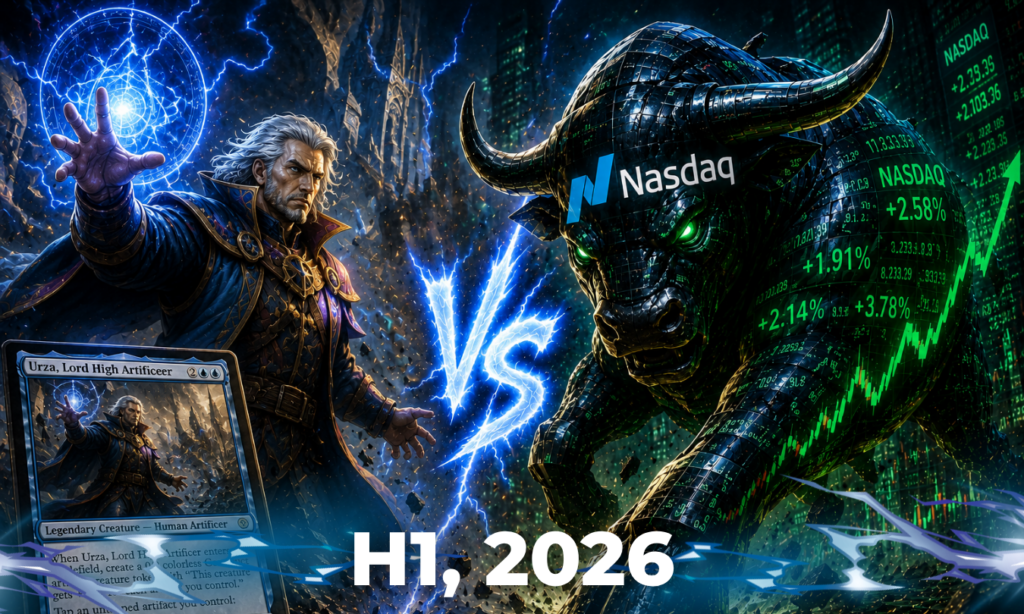
The fourth and final instalment of our H1 2026, Cards vs Capital series, and appropriately the most layered. Magic: The Gathering is the oldest major TCG in the hobby, we are talking a game that has been running since 1993, (yes, before Pokémon Younglings), and its investment market reflects that complexity. Unlike Pokémon’s broadly shared anniversary momentum or One Piece’s category wide mega jump, the MTG market in H1 2026 told several entirely different stories all at the same time, depending on which corner of it you were sitting in. Buckle up and lock in.
The benchmark, as throughout this series, NASDAQ 100 returned +17.92% in H1 2026, as of June 29. That is a genuinely strong result and the number every other asset class in this series is measured against.
The Reserved List: Having a Moment (Finally)
If you are new to MTG investing, here is the single most important concept you need to understand, the Reserved List. It is a formal commitment made by Wizards of the Coast (the company that makes Magic) never to reprint a specific list of older, powerful cards (honestly kind of insane that as a company, they did this). Think of it as Magic’s equivalent of a First Edition stamp, except Wizards actually wrote it into policy, which is more than Pokémon or Yu-Gi-Oh have ever done. Reserved List cards are permanently, structurally scarce in a way that most TCG cards simply are not.
And in H1 2026, the Reserved List was having a genuine moment. Multiple sources confirmed broad double-digit growth across Reserved List cards since the start of the year. Some specifics: Mox Diamond crossed the $1,000 USD barrier and kept climbing to a new all-time high. Mox Opal hit $1,139.99 USD. Gaea’s Cradle made it past the psychologically significant $1,000 USD price point by May. Specific Reserved List cards tied to the resurgent Premodern format (think of Premodern as a “retro.old school” if you will, format where players use cards from the original era of Magic, like vintage car collectors rather than daily drivers) broke $1,000-$1,700 USD at new price highs through March.
The driver behind much of this was the genuine revival of player interest in older formats, which created real, organic buying pressure rather than speculative positioning. Player demand means people actually need the cards, not just want to hold them, and that is a more durable foundation for price appreciation than hype alone. And generally nice to see people wanting cards to use instead of just for the cash. For investors holding strong Reserved List positions going into 2026, the first half broadly delivered returns that were competitive with and in some cases exceeded the NASDAQ 100’s 17.92% benchmark. Good times for the ol Magic cardboard.
Universes Beyond: Serialised Cards Continue to Print
Universes Beyond is Wizards’ programme that brings other big IP (intellectual property, basically other brands and franchises) into Magic card form, for the younger ones, its like how Fortnite has skins for characters from multiple universes… that reference hurts to even type. Think Lord of the Rings, Final Fantasy, Spider-Man, Teenage Mutant Ninja Turtles. The most valuable category within these sets is serialised cards, prints numbered X/100, meaning there are literally only 100 of that specific card in existence globally… ooh yeah baby that’s scarcity. That is a hard supply cap that no amount of future printing can undo, and it makes serialised cards one of the few places in modern MTG where scarcity is genuinely structural rather than just temporary.
These cards had a strong H1 2026. The FINAL FANTASY set’s serialised chase cards held above $1,000 USD. Sephiroth was up 37.38% in June alone, partly driven by the announcement of Final Fantasy 7 Remake’s third game. Sauron from the Lord of the Rings set was up 27.41% over the same window. We covered what happens when a single visible buyer starts consuming these sets in our piece on Penguinz0 accidentally tripling the price of Magic’s most expensive box, the underlying point being that thinly traded, serialised product can move dramatically on relatively small buying activity.
Collector Boosters: The Cautionary Tale
Not everything in MTG had a strong H1, and we are going to be straight with you about it. Collector Boosters, the premium, big money packs that contain alternate art, foil, and other fancy versions of cards, spent H1 2026 in a correction after a speculative boom in prior years. Too much money chased too much premium product, prices got ahead of their fundamentals, and H1 2026 was the hangover after the big night. Several modern Collector Booster products underperformed both the broader MTG market and the NASDAQ 100 benchmark in the same time period.
This is a point we have made before and will keep making: buying premium sealed product at peak hype is almost always the worst entry point, yeah that FOMO will get ya. We covered this dynamic in the $2 Pack Problem. The Collector Booster correction is a textbook example, and no doubt we are sure many are currently learning that.
Competitive Singles and Commander: Quietly Solid
Away from the drama at the top and bottom ends of the market, the middle of MTG, competitive singles and popular Commander staples, just quietly got on with performing well. Mystical Archive cards (beautifully illustrated reprints of classic spell cards) posted gains of 40-129% on specific pieces in June, just to clarify, this is good. Commander staples like Smothering Tithe held firm. Cards relevant across multiple formats showed sustained, player-driven demand that produced durable appreciation rather than speculative spikes, avoiding hype cycles essentially and holding/gaining value. Not the headline number, but the kind of steady compounding that long-term investors actually want.
The Honest Caveats
Same rules apply here as in every piece in this series.
Liquidity. Reserved List cards, particularly older and more obscure ones, can take time to sell to the right buyer. The market is narrower than Pokémon. Less demand, be patient, hold, and you will find a buyer in due time.
Cost basis. Grading fees, marketplace fees, shipping, storage, all of these eat into the headline return numbers. The gross figure looks strong. The net figure is always more honest and always lower.
Segment variance. The gap between MTG’s best and worst performing segments in H1 2026 was enormous. Holding the right things in this market is everything.
The Verdict: H1 2026
Magic delivered a genuinely split H1 2026.
Reserved List cards, serialised Universes Beyond product, and strong Commander/competitive singles broadly matched or exceeded the NASDAQ 100’s 17.92%. This is not something to shrug at, yeah its not One Piece numbers, but it’s sustainable and less likely to crash. The Reserved List in particular had one of its better half-years in recent memory, driven by real player demand rather than pure speculation (yes, it does happen occasionally).
Collector Boosters and modern speculative sealed product likely underperformed the NASDAQ 100, sometimes meaningfully, depending on specific products. Knowing which MTG to hold remains the central skill in this market.
Looking ahead to H2 2026, the catalyst that has the whole MTG community watching is the upcoming Hobbit set, expected later in the year. Lord of the Rings Collector’s Boxes are already trading at $12,000 USD, and a Tolkien-universe follow-up to what has already been one of Magic’s most valuable Universes Beyond releases is going to generate serious secondary market attention. Serialised cards from the Hobbit set, if structured similarly to the Lord of the Rings release, will be among the most-watched TCG products of H2 2026. Position yourself accordingly.
We will revisit the full year in January 2027. Want to see what your MTG collection might look like by 2030? Run it through our MTG Collection Value Estimator.
Disclaimer: The TCG Times is a news and educational platform. All content provided is for informational purposes only and should not be construed as professional financial advice. Trading cards are high-risk, volatile assets. Past performance is not indicative of future results. All comparisons are for educational purposes only. Always perform your own due diligence before making any financial decisions. The NASDAQ 100 return figure is sourced from Slickcharts as of June 29, 2026.