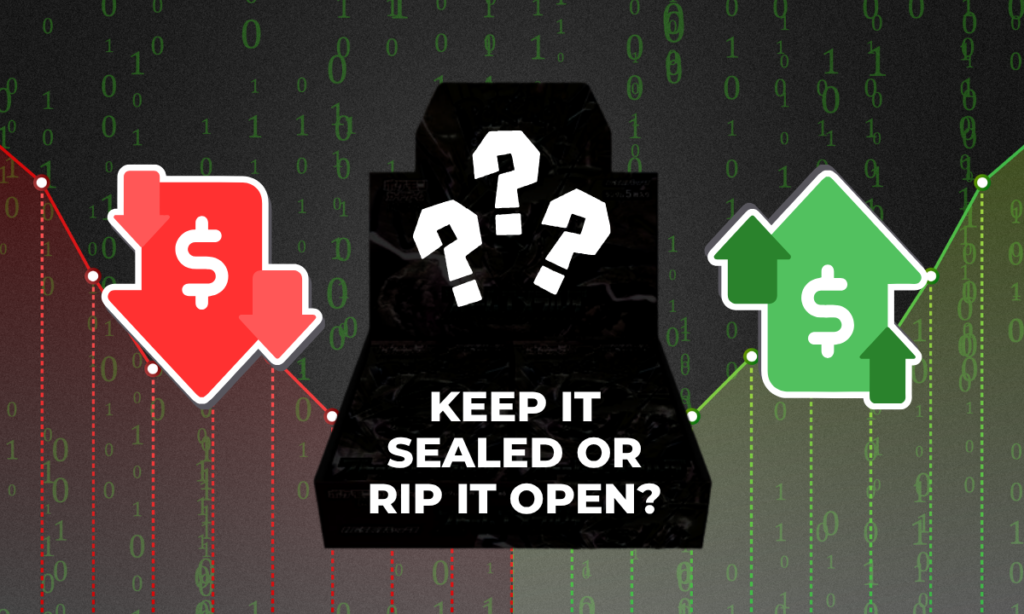
If you’re reading this, we already know you probably have sealed product taunting you, like it’s the Green Goblin mask telling you to open it. The part of you is telling yourself that if you just open it and sell the pulls, you will probably make your money back anyway, but do you want to maybe make your money back or do you want real profit?
Here at The TCG Times, we are going to give you the honest answer: sometimes the logic of that initial thought actually holds up, and sometimes it absolutely does not. The difference between those two outcomes is a number that many TCG investors will never actually calculate before they rip the entire box. We know the feeling, cause we have done it, many of you reading this probably have too. So we built a tool specifically to help you work it out before you do anything you cannot undo BUT first, let’s go through why this calculation matters, as having the background info will make your investment choices potentially far more profitable. Who doesn’t want to make more MONEY!
The Problem With “I’ll Just Sell the Good Pulls”
The classic mental gymnastics most collectors use when deciding whether to rip a sealed box or not usually goes something like this: “The box cost me $X, all I need is one decent pull to cover it, and everything else I get is profit.” This can sound somewhat reasonable… BUT falls apart pretty quickly when you actually do the maths. Yes maths, if you want to make better investment decisions and more profit, a little math goes a long way, but don’t worry with the tool we built, you don’t even need to do it.
Here is what that mental model tends to miss:
Starting with marketplace fees, they are not small. eBay usually takes 13.6% plus $0.40 per card sale and TCGPlayer takes around 10.25% plus the additional payment processing. Think about it this way by the time you have sold 20 cards at $5 USD each, you would think you have just banked a sweet $100 USD, when in reality you have actually received closer to $80-85 USD after platform and payment processing fees. Now $15-20 USD may not sound like a massive pain, but that gap matters a lot more when you are trying to cover a $150 USD box cost.
Shipping costs adds up…Fast You have to consider if you are posting individual cards, packaging materials (envelopes, bubble wrap/cardboard), penny sleeves/top loaders and postage eat into every single sale. Even at $1 USD per card in shipping costs, on 20 cards that is an extra $20 USD off your total. And that is assuming you are shipping pretty damn efficiently, plenty of sellers spend more than that.
Not all the cards sell... awkward…. Aside from selling bulk as a single lot, selling commons and uncommons individually in most cases is quite difficult to move at a “fair” price. The normal calculation most people in the “rip a box and sell everything inside” category run in their head almost always assumes they will sell everything they pull. The honest truth is that most of the time 3-5 cards do the heavy lifting in making the cash side and the rest sit in as old listings in marketplaces.
Running the Numbers Properly
The break-even calculation: the specific average price per card you need to hit across all the cards you sell to cover your box cost is not complicated, but it requires accuracy and a bit of thinking. Here is a simplified version:
Take your box cost. Divide it by the number of cards you realistically expect to sell not all cards in the box, just the ones with genuine resale value. Then add to that number the marketplace fee on each sale and any shipping costs for each sale. The resulting number is your break-even price per card. If your honest estimate of what you will average per card is above that number, opening makes financial sense. If it is below it, you are destroying the sealed value for a net loss.
Running this calculation is doable but fiddly and honestly boring, especially when you are trying to factor in multiple different marketplace fees (eBay vs TCGPlayer vs Cardmarket all charge differently) or comparing multiple different boxes or products. Which is exactly why we built the TCG Sealed Box Break-Even Calculator. We even use it ourselves.
Use the Calculator Before You Touch That Box
Seirously it so easy, just punch in the price you paid for any TCG products, then how many cards you plan to sell (be honest), your expected average sale price, then lastly your marketplace of choice (the calculator pre-fills typical fee rates for eBay, TCGPlayer, Cardmarket, and Facebook Marketplace, and you can also enter custom rates… you’re welcome), and of course your shipping cost per card. It will spit out the break-even price per card, your projected net profit, total fees and shipping, and your return on investment. Plus, you can do it in your preferred currency, we know TCG investors are in every country!
→ Run your numbers now: TCG Sealed Box Break-Even Calculator
The best part, if the numbers on the calculator say open, great rip that box with confidence, woo woo! If the numbers say hold, then back to the shelf it is. The idea is it does all the work for you and that is a much nicer feeling than opening something and realising halfway through that the maths was never going to work out.
Disclaimer: The TCG Times is a news and educational platform. All content provided is for informational purposes only and should not be construed as professional financial advice. Trading cards are high-risk, volatile assets. Always perform your own due diligence before making financial decisions.