
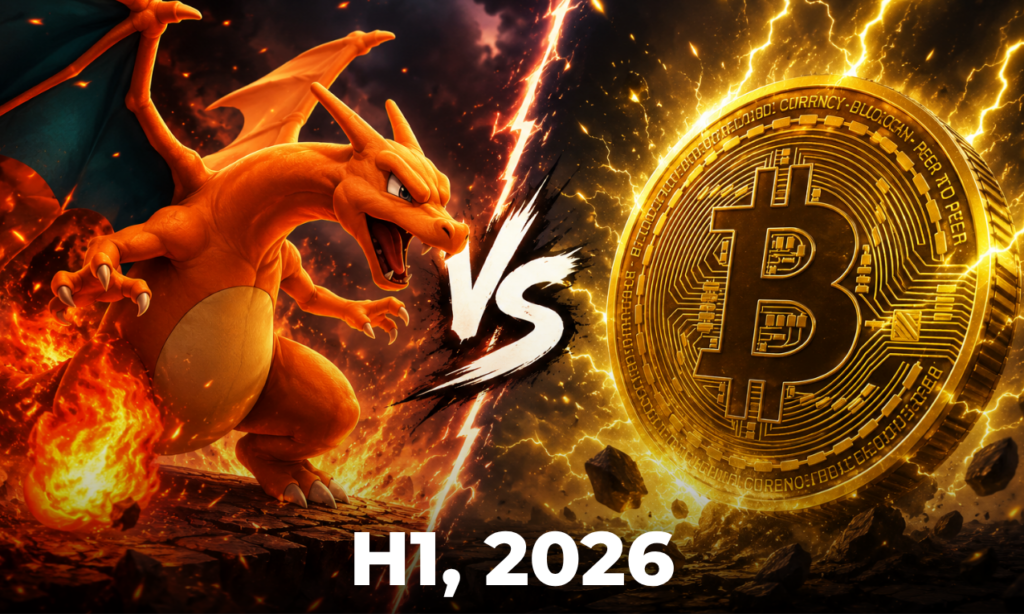
That’s right, it’s time for the most anticipated crossover of the year! The finance bros (and bro-ettes) meet the Pokémon “Investors”…. (it’s a joke, chill out homie) Let’s get into it.
Every now and then, the world of traditional investing throws up a result that makes even the most emotionless financial brain do a double take. We think H1 2026 is one of those moments, because Bitcoin, the asset that millions of people chose as their high-growth, high-risk alternative investment for the year, lost approximately 40% of its value (sorry, crypto bros) between January 1 and June 30. Meanwhile, a well-positioned Pokémon collection was doing something very different. Let us break it down.
First, The Bitcoin Number
Bitcoin opened 2026 somewhere in the neighbourhood of $97,000 USD (honestly, not too bad) riding momentum from its October 2025 all-time high of $126,198. It felt unstoppable at the time. By June 30, 2026, the price had fallen to approximately $58,503. That is a loss of around $38,500 per coin, or roughly -40% in six months.
For context: if you had $10,000 in Bitcoin on January 1, you had roughly $6,000 by the end of June. Not ideal...
We are not here to pile on Bitcoin, we know plenty of people who have made some serious cash! It has genuinely extraordinary long-term returns over its entire history, and it may well recover strongly in H2 of 2026. But for H1 2026 specifically, the comparison to Pokémon is striking enough that it deserves an honest look.
What Was Happening With Pokémon While Bitcoin Was Falling?
While crypto investors were watching their portfolios shrink, the Pokémon TCG market was doing something quite different. The 30th anniversary celebration kicked off formally on Pokémon Day, January 30, sending a wave of buying pressure through the entire secondary market that built throughout Q1 and Q2. Our personal favourite… nostalgia.
The headline figure: the Card Ladder Pokémon index increased by approximately 116% over the past year, with January 2026 specifically described by market trackers as a “watershed moment” (think of that as a turning point where the market really accelerated). The TCGFish Sealed Index, which tracks the value of Pokémon sealed product, was up +13.52% in just the three months to February 8, 2026 before the anniversary momentum had even fully built. Graded cards were up +12.84% in the same window.
Within H1 2026, the standout performers were older sealed tins from the Celebrations set (up 39-65% as the 30th anniversary approached), anniversary-linked modern products, and high-grade vintage cards with a PSA 10 rating, which broadly gained 30-50% across the period.
So while Bitcoin fell roughly 40%, a well-positioned Pokémon portfolio was delivering double-digit, and in some segments triple-digit returns. That is a genuinely remarkable gap, and one that most people outside of this hobby would not believe if you told them.
The Caveat That Actually Matters
Before you screenshot this article and send it to every crypto investor you know (tempting, we know, and we won’t be mad if you did), we want to be upfront about why this comparison is not as simple as it looks.
Liquidity. Bitcoin can be sold in seconds, anywhere in the world, at 3am on a Sunday. A PSA 10 Charizard takes days to weeks to sell, involves marketplace fees of 12-15%, and requires finding the right buyer, and often more questions than you can poke a stick at. The Pokémon number is what someone listed. The Bitcoin number is what you actually got.
Bitcoin’s track record over time is extraordinary. We are comparing one six-month window, which happens to be one of Bitcoin’s worst half-year periods in recent memory. Over five years, ten years, Bitcoin has significantly outperformed almost every other asset class on earth. A single bad half does not erase that history, and we want to be honest about that.
Not all Pokémon cards went up. The 116% headline figure reflects the market’s strongest performers, the classic vintage cards, anniversary-adjacent product, and high-grade PSA copies. A collection full of overprinted modern singles may have done very little in the same period. The index captures the best of the market, not the average collector’s experience.
The anniversary tailwind was real but not permanent. The 30th celebration supercharged H1 2026 in a way that will not simply repeat in H2. That said… the 30th Celebration set drops September 16, and as we covered in our September selling piece, anniversary set releases have a documented track record of pushing older cards and sealed product higher around launch. H2 has its own catalyst in the making.
The TCG Times’ Verdict: H1 2026
In the first half of 2026, a well-positioned Pokémon portfolio outperformed Bitcoin by a margin that would have seemed absurd to write twelve months ago. Bitcoin, the asset most associated with “high risk, high reward” alternative investing, delivered roughly -40%. Pokémon’s strongest segments delivered multiples of that in the positive direction.
Does that mean Pokémon is a better investment than Bitcoin forever? No. Does it mean H1 2026 was an unusual, data-backed moment where cardboard genuinely won? Absolutely. We will revisit both numbers in January 2027 with the full-year picture. Want to see what your Pokémon collection might look like by 2030? Run it through our Pokémon Collection Value Estimator.
Disclaimer: The TCG Times is a news and educational platform. All content provided is for informational purposes only and should not be construed as professional financial advice. Trading cards and cryptocurrencies are both high-risk, volatile assets. Past performance is not indicative of future results. Always perform your own due diligence before making any financial decisions. Bitcoin price data sourced from Fortune and StatMuse. Card performance data sourced from Card Ladder and TCGFish.
Pingback: TCG Cards vs LEGO: Which One Actually Makes More Money? - TheTCGTimes.com