
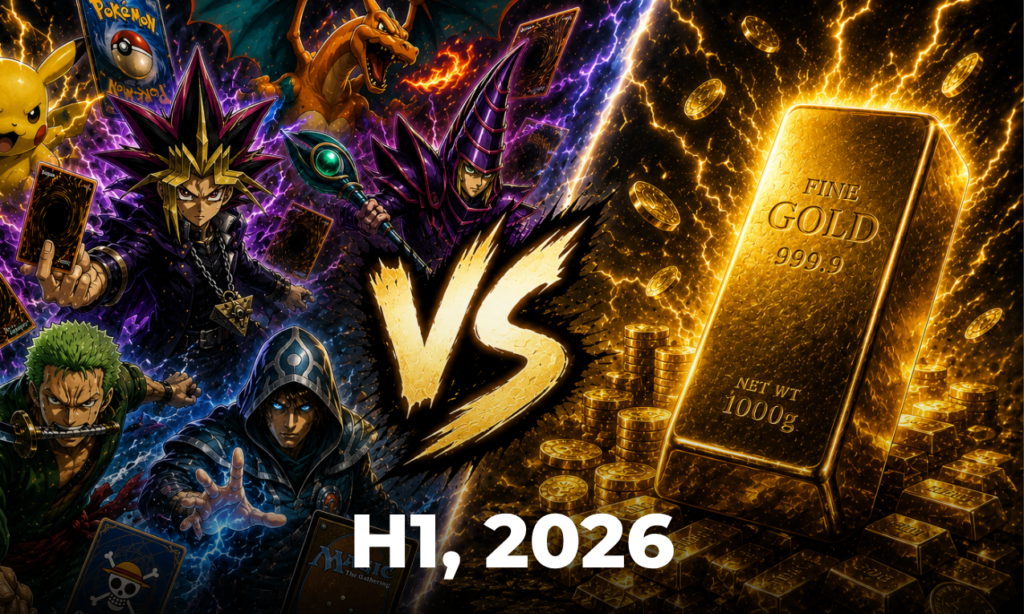
Gold has been a store of value for roughly five thousand years, a little while before TCGs came onto the market. Trading cards have been around for about thirty. On paper, this should be the most lopsided comparison in our entire Cards vs Capital series. And yet H1 2026 threw up a genuinely interesting result, because gold, the world’s most ancient asset, had one of the most dramatic and ultimately disappointing first half-years in recent memory. Which meant the cardboard had a genuine shot at beating it. Wild when you think about it, the fact cardboard can be worth more than gold…. Let us look at what actually happened.
Gold’s Extraordinary (And Ultimately Deflating) H1 2026
If you missed it, gold had a genuinely wild start to 2026. Driven by geopolitical anxiety, specifically around the US-Iran conflict. Gold rocketed from approximately $4,310 USD per ounce at the start of January to an all-time intraday high (means it hit a daily high during trading times) of $5,602.22 USD on January 28, 2026 (if you’re not too aware of gold, that’s a lot of $ per ounce). Central banks were buying, institutional investors were piling in, and for about three weeks it felt like gold’s bull run had entered a new era entirely. Seemed like a modern-day gold rush.
Then the paradox kicked in. The very same Iran conflict that initially sent gold soaring also pushed oil prices higher, which complicated the Federal Reserve’s inflation picture, which strengthened the US dollar, and a stronger dollar is generally bad for gold. By June 30, 2026, gold had fallen all the way back to $4,007.69 per ounce, ending the half down approximately -7% for the year, despite having hit an all-time high less than five months earlier. Yeah, we know that bit was a bit boring, so to sum it up, the war in Iran made gold prices go up really high, and then it made them go down even more than it went up before….
So the benchmark for this comparison is gold: -7% in H1 2026. Now let us see what the cardboard did.
Pokémon vs Gold: Not Close
Pokémon’s strongest segments delivered returns in the 30-50% range for vintage graded cards and up to 65% for specific Celebrations-era tins during H1 2026, with the Card Ladder Pokémon index showing approximately 116% growth over the past year. Against gold’s -7%, this is not a close fight, this was a beat down. A well-positioned Pokémon portfolio in H1 2026 outperformed gold by somewhere between 37 and 57 percentage points depending on what you held, and that gap would be even wider for collectors who were concentrated in the right anniversary-adjacent products.
The structural argument for Pokémon over gold as a long-term hold is also genuinely interesting beyond just this half-year snapshot, it’s a thought that’s appearing more and more often. Gold’s price is driven largely by macroeconomic forces (we are just trying to sounds fnacy is just means large-scale economic trends as a whole) interest rates, currency movements, and geopolitical risk, which are largely beyond any single investor’s ability to predict or control. Pokémon’s long-term price drivers, nostalgia, demographics, genuine scarcity on vintage product, and a global IP that keeps bringing new collectors in every day, are more predictable over a multi-year horizon, even if the short-term volatility is higher. We broke down the full framework for evaluating TCG card value in our Four Pillars piece, and none of the four pillars depend on what the Federal Reserve decides to do next month.
Yu-Gi-Oh vs Gold: Segment Dependent, But Largely Ahead
Yu-Gi-Oh’s top rarity cards, you know them, we have spoken about them, the Starlight Rares and Quarter Century Secret Rares that we keep returning to in our coverage, showed consistent double-digit appreciation in H1 2026, comfortably beating gold’s -7%. Even the competitive staple segment, which is the most volatile and reprint-exposed category in Yu-Gi-Oh, likely outperformed gold on a gross basis in most cases, because even a flat result beats -7%. Honestly not a bad start to the year.
The genuine fear for Yu-Gi-Oh specifically is that reprint risk can deliver the same rapid, unexpected correction that gold experienced in H1 (it can drop card prices drastically) just from a different cause. Gold fell because macroeconomic forces shifted. A Yu-Gi-Oh card can fall because Konami announces a reprint in a structure deck. The mechanism is different but the outcome for the holder can be uncomfortably similar. We covered this in the reprints trap, and it is the one parallel between gold’s H1 experience and the risk profile of mid-rarity Yu-Gi-Oh holdings.
One Piece vs Gold: The Most Dramatic Gap
Against gold’s -7%, One Piece’s +119% H1 2026 index return is so disproportionate that the comparison barely makes sense numerically. Like that sentance alone sums it up, but we will give a quick breakdown. The markets are simply operating on completely different timescales and at completely different stages of maturity. Gold is a five-thousand-year-old asset in a mature, globally liquid market. One Piece TCG is a four-year-old card game still in the early stages of its collector market developing. And now they are head-to-head in an asset investment breakdown, kinda funny.
The more interesting comparison is the philosophical similarities: both gold and One Piece early sealed product derive their value from genuine, finite, non-replenishable supply… scarcity. Gold’s supply is limited by what exists in the earth. An OP-01 Romance Dawn booster box’s supply is limited by what Bandai printed in 2022. Neither can be manufactured on demand. That is the same underlying investment logic, scarcity combined with sustained demand, expressed across two very, very different asset classes at very different stages of maturity.
Magic vs Gold: The Closest Parallel of All
Of all four TCG franchises, Magic’s Reserved List cards share the most direct philosophical overlap with gold. Both are:
- Formally, explicitly protected from new supply creation (the Reserved List – gold’s physical scarcity)
- Valued by a global community with multi-decade history (Magic being the OG of TCGs)
- Used as long-term stores of value rather than short-term plays
- Priced in part by their role as hedges against uncertainty in other markets
Against gold’s -7%, Magic’s Reserved List had a stronger first half, double-digit growth on multiple headline cards. The serialised Universes Beyond cards added another performance layer on top of that. And while gold experienced its dramatic peak-and-collapse cycle driven by geopolitical forces (US-Iran war) nobody predicted correctly, Magic’s Reserved List moved in a more linear, demand-driven direction throughout H1.
To sum it up in a way we can all understand: gold is what people buy when they are scared of everything else. Magic’s Reserved List is what Magic investors buy when they are scared of reprints. Both share the “scarcity is the value” logic. In H1 2026, the cardboard version of that thesis performed better.
The TCG Times’ Verdict: H1 2026
Gold had a first half that looked extraordinary for a short amount of time and ended in negative territory. Meanwhile, across all four TCG franchises we track, the well-positioned investor in the right categories outperformed gold’s -7% H1 return, in some cases by a very wide margin.
That is not an argument that TCG cards are better than gold forever, or that gold does not belong in a diversified portfolio. Gold’s role as a macro hedge (minimise risk across a whole portfolio), its deep liquidity, and its five-thousand-year track record are not things cardboard can simply replace. But for H1 2026 specifically, cardboard won this comparison across the board (with some slight geopolitical luck). And we think that is worth knowing.
We will revisit all of these comparisons in January 2027 with the full-year data. Until then, take care of your cards, check your prices, and keep thinking about the money side of this hobby. That is what we are here for.
Disclaimer: The TCG Times is a news and educational platform. All content provided is for informational purposes only and should not be construed as professional financial advice. Trading cards and commodities are both volatile assets. Past performance is not indicative of future results. Always perform your own due diligence. Gold price data sourced from the World Gold Council, APMEX, and Investing News Network. Card performance data sourced from Card Ladder, TCGFish, and publicly available market reporting.

Pingback: TCG Cards vs LEGO: Which One Actually Makes More Money? - TheTCGTimes.com