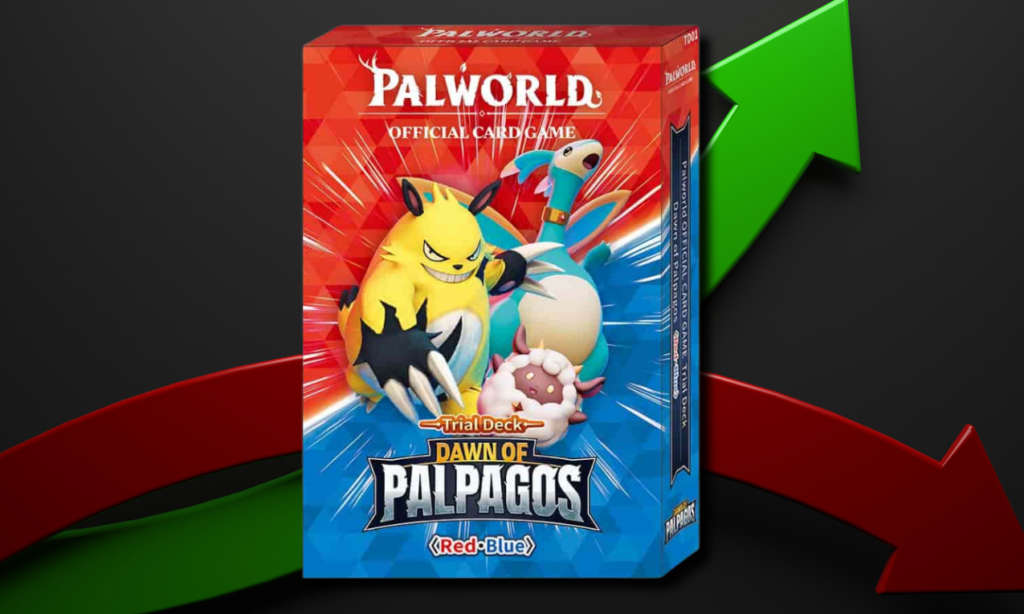
Let us get one thing straight before we go anywhere near the investment case: the Palworld Official Card Game launching on July 30, 2026, nine days from the time we are writing this, is one of the most commercially interesting TCG launch windows we have seen in years. Three and a half million booster packs pre-sold before a single card has been cracked in anger… 3.5 MILLION for a card game that doesn’t have a manga or anime background! Major retailers already showing pre-orders as sold out. A 40-million-player fanbase (dman solid) fresh off what is arguably the biggest gaming update of 2026 in Palworld’s 1.0 launch on July 10. Yeah, this one’s going to be wild.
The short-term case here is real. The long-term case is where we get honest with you in a way most people covering this launch are not (you’re welcome) because here at The TCG Times, we always follow the money, not the hype.
The Launch Setup Is Genuinely Extraordinary
Here is the timeline, because the timing genuinely matters for investors.
Palworld 1.0 dropped on July 10, 2026, ending the game’s two-and-a-half-year Early Access period. It is the biggest update in the game’s history, 27 pages of patch notes, a brand-new endgame zone, new Pals bringing the total roster to 287, and the first paid DLC already lined up for, wait for it, July 30, the exact same day as the TCG launch…. well played. Pocketpair did not accidentally schedule these together. The entire Palworld content calendar for July is pointing at a single cultural moment, and the TCG is landing right in the middle of it.
This matters for investors because peak IP momentum and a new TCG launch are rarely or ever this perfectly aligned. The game’s player count was already holding at approximately 35,000 concurrent Steam players on ordinary days before 1.0 dropped, with spikes far above that during update windows. Post-1.0 numbers will are significantly higher. These are active, engaged players who already know the characters, already have emotional connections to specific Pals, and are now being handed a physical product to collect. At 40 million total players, even a small percentage is a very large number.
3.5 million packs pre-sold before launch is the number that tells you the market has decided this is worth taking seriously. Not one influencer telling you, the MARKET is telling you. For context, most brand-new TCGs launch with measured, conservative initial numbers while the market figures out whether anyone cares. Palworld TCG had its answer before the product even existed in physical form. As One Piece had the anime and manga to lean on pre-TCG launch, Palworld has a cult-like following on its video game to lean on.
What the Product Actually Is
The Palworld Official Card Game is published by Bushiroad (yes, this matters, just be patient), the Japanese publisher behind Cardfight!! Vanguard and Weiß Schwarz, yeah we don’t know much about those games either… but it is launching in collaboration with Pocketpair. It launches simultaneously in English, Japanese, and Simplified Chinese, which is a genuine point in its favour, no 3-month gap, no fragmented market, worldwide demand concentrated on a single release window (a lesson the TCG industry has been learning from One Piece’s simultaneous global launch success).
It is a 2-player competitive card game where players deploy Pals, collect resources, and build bases, directly reflecting the mechanics of the video game rather than just slapping Palworld art onto a Pokémon TCG clone (let’s be honest that kinda what we all were expecting). That distinction matters for whether it builds an actual playerbase, and for investor purposes, a genuine competitive playerbase is one of the most reliable demand anchors any TCG can have (aside from a nostalgic audience).
Set 1 cards feature all-original artwork (we like this) not reused assets from the video game, which is a significant positive for the collector side of the market, it makes it look like they are actually taking it seriously. Original artwork in TCGs commands collector premiums in a way that repurposed game art does not, and it signals that Bushiroad and Pocketpair are treating this as a serious, standalone product rather than a cash-in on existing assets. For anyone thinking about the four pillars of card value, aesthetics is doing real work here from day one.
One more thing worth noting: the Nintendo lawsuit that hung over the Palworld IP for two years, the patent infringement suit from The Pokémon Company has apparently settled for what has been described as a genuinely negligible figure. The legal shadow is gone. Pocketpair can operate the IP freely going forward without that cloud affecting collector confidence. Basically, they are off the hook and can now do pretty much whatever they want.
The Short-Term Case: Buy the Launch Window
We rarely give this kind of direct call, so we want to be clear about why we are giving it here.
The launch window, the weeks immediately surrounding July 30, has the makings of a significant demand spike. The catalysts are all real: a massive, engaged player base at peak excitement off the back of 1.0, no supply yet on the secondary market (legit 0….), retailers already sold out of pre-orders, and a cultural moment for the IP that will not repeat at this intensity. If you are looking at this purely as a short-term play, buy at launch, hold for the opening spike, sell into the excitement rather than after it, the setup is as good as we have seen for a brand new TCG.
This is not a Pokémon 151 situation (which we compared to Celebrations in our set comparison piece) where deep nostalgia from multiple generations anchors long-term demand. This is a launch window play. The 90-day rule we apply to new sets exists precisely for situations like this, the first 30 days of any new TCG launch are the noisiest, most distorted period for pricing. But the launch window spike itself is real and worth capturing if that is your intent going in. Please note there is still risk, it’s TCG investing, it is highly volatile.
The Long-Term Case: This Is Where We Pump the Brakes
Okay. We said we would be honest with you, so here it is.
The single biggest structural weakness of the Palworld TCG as a long-term hold is that Palworld has no manga, no anime, and no narrative IP beyond the video game itself. That might sound like a small thing, so let us explain why it is actually enormous.
Pokémon’s TCG card values are sustained across decades not just by the card game, but by an anime that has been running continuously for nearly thirty years, bringing in new fans every generation. The collectors spending serious money on vintage Pokémon cards right now were emotionally attached to those characters through the show, not just the cards (a lot of us watched the show before going to school back in the day… on tv with ad breaks!). One Piece has a manga that has been running for nearly thirty years and an anime with a global fanbase that dwarfs any single video game’s audience.
Palworld is a video game. A successful one, 40 million players is genuinely remarkable. But video game popularity is volatile in a way that manga and anime fanbases are not. Palworld’s peak concurrent Steam numbers from its January 2024 launch reached over 2 million. By mid-2026 before the 1.0 update, that had settled to approximately 35,000 on ordinary days (35k on a normal day is still very high in general). That is not the trajectory of a Pokémon. It is the trajectory of a very good video game that had an extraordinary launch moment. The cultural half-life of a video game IP, without supporting narrative media, is fundamentally shorter than the cultural half-life of a manga or anime IP. When game updates slow down, so does player engagement, and with it the emotional investment that drives collector demand. No demand, no cards, no money to be made….
There is also the Bushiroad factor to consider plainly. Bushiroad has never broken meaningfully into the Western TCG investment market with any of their existing games. Cardfight!! Vanguard has had dedicated communities in Japan for years and has made limited headway outside it. Weiß Schwarz is beloved by anime fans but has never produced the kind of secondary market appreciation that Pokémon, Yu-Gi-Oh, MTG, or even One Piece generate. Palworld TCG is Bushiroad’s best shot at Western market relevance, the IP is genuinely global in a way their previous games were not but the track record of the publisher in building a sustained Western collector market is a legitimate concern for anyone planning to hold for 3-5 years.
Quick note, let’s be real here, Palworld the game is essentially Pokemon having a baby with Minecraft…. both Pokemon and Minecraft are 2 of the biggest players in gaming, ever. Palworld has potential to continue to build their game for years on years to come, if doing so the Palworld TCG has potential for long-term holders, but we haven’t seen many games able to withstand the test of time in recent years.
The Play We Would Make
Buy sealed product at or near launch retail, with a clear exit target and a clear time horizon. This is not a hold-until-2030 play. It is a play on peak IP momentum, peak launch excitement, and a 40-million-player fanbase at maximum cultural engagement. Those conditions are real right now. They may not be in two years.
Set your exit before you buy. When does the launch excitement fade? When does the 90-day post-release market give you a cleaner picture of where prices are settling? Those questions have answers, and the investors who do well here will be the ones who bought with a plan rather than chasing the spike in week three and selling in panic during the inevitable correction.
If you find yourself falling in love with the idea of holding Palworld cards for the long term the way you might hold an OP-01 box or a first-edition Base Set card, we would gently suggest revisiting whether you are investing or collecting. There is nothing wrong with collecting. But the investment logic is different, and knowing which one you are doing before you spend the money is how you avoid expensive surprises later. TO be honest we caught our sleves not relasing if we were thinking like an investor or collector on this one…. and remeber is okay to collect and not make money on the product you’re collecting… losing money if you are trying to invest is a different story.
The TCG Times’ Verdict: Real Opportunity, Limited Time Frame
The Palworld TCG launch is one of the most commercially compelling new TCG moments of 2026. Buy the launch window if that is your strategy, with your exit price set before your purchase price. The long-term hold argument, in our honest view, requires believing that Palworld will sustain cultural relevance through media beyond the video game… and right now, there is no real evidence that is coming (it could… but no data or proof). That changes the investment case significantly compared to the franchises we back for long-term portfolios. Watch this one closely. Move fast if you move at all. And whatever you do, do not let the excitement of a genuinely hot launch moment extend your planned hold period beyond what the fundamentals actually support. Although we understand the excitement, it’s not every day a new TCG with millions of $ backing gets launched.
Disclaimer: The TCG Times is a news and educational platform. All content provided is for informational purposes only and should not be construed as professional financial advice. Trading cards are high-risk, volatile assets. Past performance is not indicative of future results. Always perform your own due diligence before making any financial decisions.