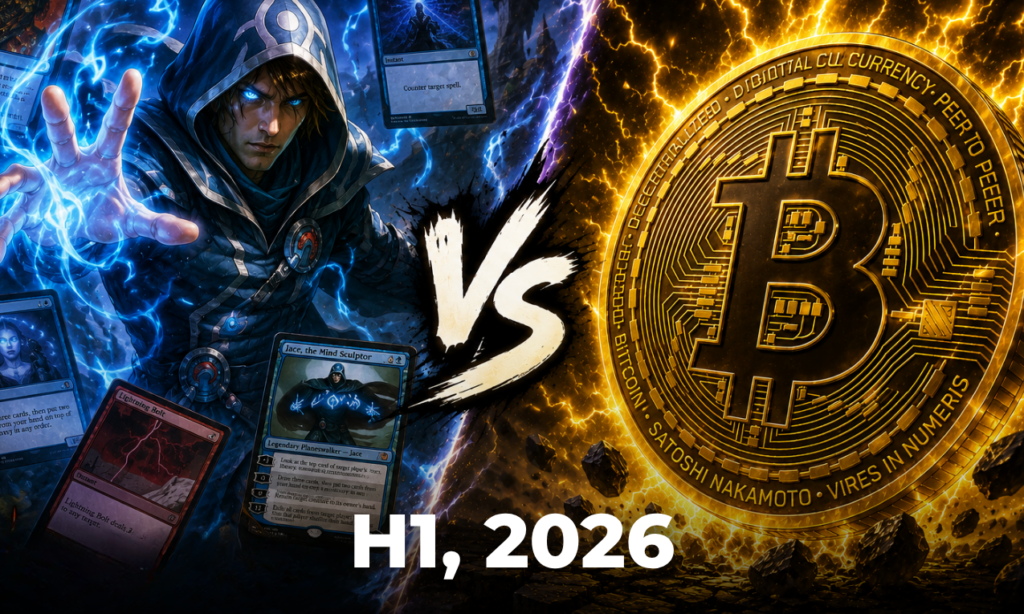
The final instalment in our Cardboard vs Crypto series, and in some ways the most fitting comparison of the four, because Magic: The Gathering is the oldest major TCG on the planet, and Bitcoin is one of the newest major alternative assets (the classic old vs new). Between them sits a genuinely interesting question: does thirty-plus years of card market history and structural scarcity hold up better than the world’s most famous digital currency in a bad half-year? Reader, yes, it does. Let us look at why.
Bitcoin: -40% in H1 2026. A Quick Recap.
We have covered this across all four articles in this series, but for the newcomers, let’s speed this up… Bitcoin opened 2026 at approximately $97,000 USD off the back of its October 2025 all-time high, and spent the first six months of 2026 falling off a cliff…. By June 30, it was sitting at around $58,503 USD a loss of roughly -40% in six months. For context, a $10,000 Bitcoin investment made on January 1 was worth about $6,000 by the end of June. (This is not good).
That is what Magic’s cardboard is being compared against. And MTG has a very interesting story to tell.
Magic’s H1 2026: Two Very Different Stories
Magic: The Gathering is not one market (bear with us), it is several, and they performed very differently in H1 2026. We covered this in detail in our NASDAQ comparison piece, but the short version is: some segments significantly outperformed, some underperformed, and where you sat in that spectrum was almost entirely determined by which Magic cards you held. See, simple, now let’s break it down.
The Reserved List had a genuinely strong half. If you are new to Magic, the Reserved List is a formal, published promise from Wizards of the Coast (the company that makes Magic cards) that they will never reprint a specific set of older, powerful cards (we here are massive fans that they do that). Think of it as the closest thing the TCG world has to a legally-enforced scarcity guarantee… “rare cards stay rare” to simplify it for the super slow people. In H1 2026, Reserved List cards broadly delivered double-digit growth, with specific headline cards crossing significant price milestones. Mox Diamond and Mox Opal both broke $1,000 USD, Gaea’s Cradle pushed past $1,000 USD, and multiple vintage cards tied to the growing Premodern format (a retro format where players specifically seek out old-frame cards) set new all-time price highs. Against Bitcoin’s -40%, the Reserved List had a genuinely excellent first half.
Serialised Universes Beyond cards, cards numbered X/100 from special sets like Final Fantasy and Lord of the Rings, also performed strongly. These are cards where the supply cap is absolute and permanent, similar in logic to a limited edition collectible where only 100 exist in the world. Sephiroth from the Final Fantasy set was up 37.38% in June alone. Sauron from Lord of the Rings was up 27.41%, not bad at all, especially when you compare these against Bitcoin’s -40%, those numbers look excellent. We covered what happened when one buyer accidentally tripled the Lord of the Rings box market in our Penguinz0 piece (crazy good piece in our opinion) the underlying point being that these are thin, high-value markets where genuine collector demand can move prices dramatically.
Collector Boosters, the premium packs full of fancy alternate art and foil cards had a more difficult half, with several products in correction mode after speculative pricing from prior years (it can’t all be positive for the cardboard peeps). If this was your main allocation, your H1 looked more modest. Still significantly better than -40%, but not the headline story.
The Bitcoin vs Magic Structural Comparison
Here is the angle we find genuinely interesting about this specific matchup. Bitcoin and Magic’s Reserved List cards actually share more investment logic than most people realise — both are scarce, finite assets with passionate communities, no government backing, and price histories defined by boom and correction cycles. The key difference is what happens at the floor.
Bitcoin’s value, at the extreme downside, can theoretically approach zero. It is a digital token. If institutional confidence collapses and regulatory pressure intensifies simultaneously, there is no physical object providing a price floor.
A genuine Reserved List card from 1993 (old school) a Black Lotus, a Mox, a dual land, has a physical floor. It is a historically significant piece of cardboard from the birth of a game that is now over 30 years old, beloved by millions, and formally (kind of legally) protected from replication. Even in a worst-case market scenario, the object retains its historical existence and community significance. That is not nothing,
We are not saying Magic cards are safer than Bitcoin in all scenarios. We are saying the floor logic is different, and in H1 2026 specifically, the floor held up rather better than the digital alternative.
The TCG Times’ Verdict: H1 2026
Magic: The Gathering’s strongest segments… Reserved List cards, serialised Universes Beyond product, and competitive Commander staples significantly outperformed Bitcoin’s -40% H1 2026 return. The most structurally protected categories in MTG did what they are supposed to do: they held value and grew while a more volatile alternative asset fell sharply.
The weakest segment, Collector Boosters, had a more modest first half, but still outperformed Bitcoin simply by not falling 40%.
Looking ahead to H2, the Hobbit set is the catalyst the MTG community is watching most closely. A Tolkien-universe follow-up to the Lord of the Rings release, which already produced cards trading at $12,000+ USD for sealed boxes. If Hobbit content follows the pattern of its predecessor, it will be one of the most watched TCG product releases of the year. Want to see what your MTG collection might look like by 2030? Run it through our MTG Collection Value Estimator.
Disclaimer: The TCG Times is a news and educational platform. All content provided is for informational purposes only and should not be construed as professional financial advice. Trading cards and cryptocurrencies are both high-risk, volatile assets. Past performance is not indicative of future results. Always perform your own due diligence. Bitcoin price data sourced from Fortune and StatMuse.