
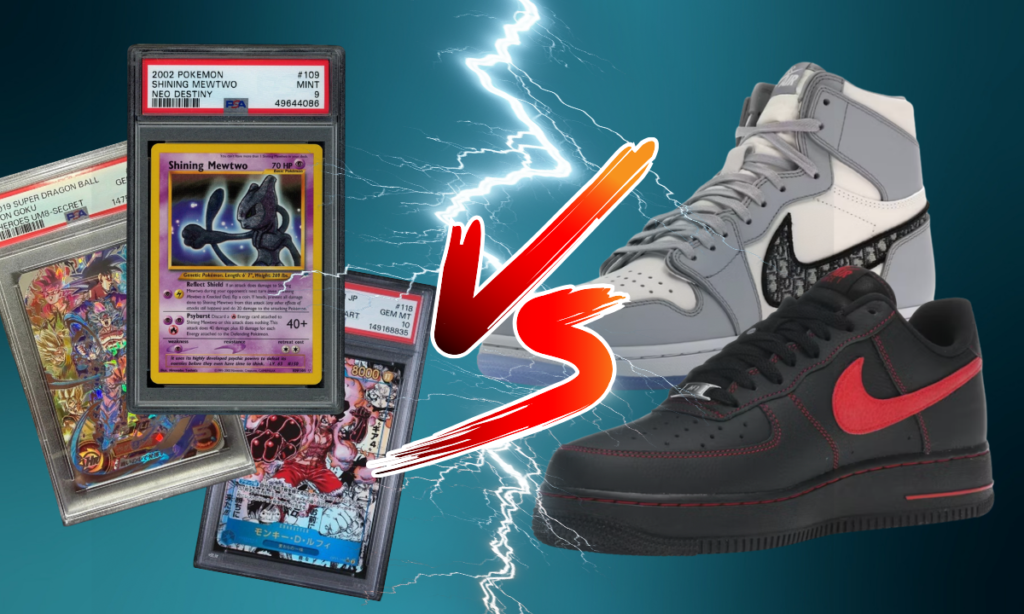
Oh yeah, we are doing it, trading cards vs. sneakers, cardboard gang vs the sneakerheads, TCG market vs. shoe market… okay, we’ll stop. If you ran a poll asking people to name the two collectible markets that most resemble each other, sneakers and trading cards would win comfortably in our opinion. Both share a lot of similarities, for example, they are driven by limited releases and scarcity, and both have strong resale platforms with real time pricing. Both attract celebrities (whether you like it or not), both have ridiculous hype culture, and lastly and most important to the $, a community of investors who take the financial side deadly seriously and have produced amazing returns on the right assets at the right time (and brutal losses when the hype train leaves the station).
So which one actually makes more money? Here at The TCG Times, we are running the numbers legitimately and as fairly as possible, using the same framework we use for every Cards vs Capital piece, honest about both sides, with real numbers rather than cherry picked wins.
The Size of Each Market
Does size matter…? Kinda. The global TCG market is worth about $15.11 billion USD in 2026, a number that is basically incomprehensible to most, and it’s growing at a compound annual growth rate of 10.03% (it grows 10.03% in value each year). The sneaker resale market is valued at around $10 billion USD globally and is growing. We would like to note that estimates vary significantly by source depending on whether they include direct retail or resale only.
Both markets have grown an insane amount over the past decade and attracted a lot of new investor attention and also created a lot of new investors during the 2020-2021 period. This was when discretionary spending spiked, partly due to COVID, and alternative assets boomed (kinda ironic that the shoe market grew while people couldn’t even go outside and walk…). Both markets experienced corrections in 2022-2023 before finding their footing in the recovery.
The Best Case: Where Each Market Has Produced Its Biggest Returns
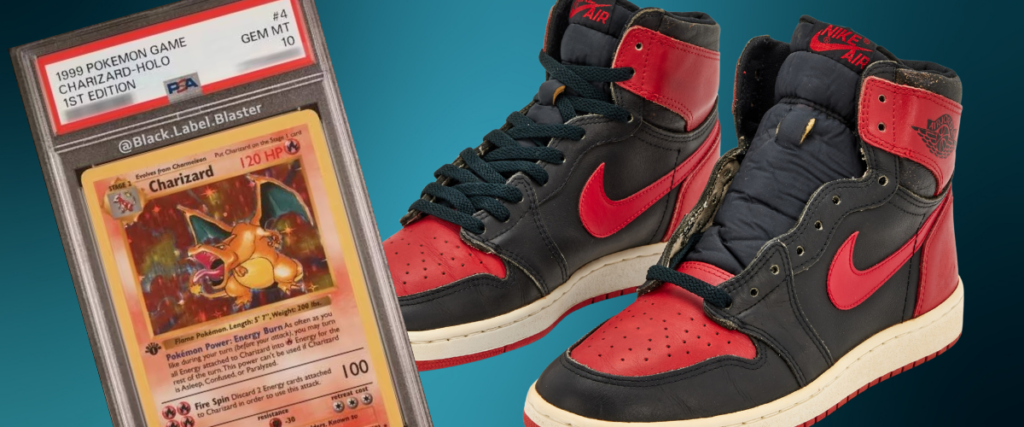
Sneakers at their best have honestly had a fairly solid history of good returns. The Nike Air Jordan 1 Chicago “Banned” (1985) retailed at $65 USD, keep in mind this was a lot of money in 1985. Graded examples in mint condition have sold for over $600,000 USD, note this is at auction. A pair of Nike Moon Shoes from 1972, part of a limited edition, only 12 were made, and 1 sold for $437,500 USD. When it comes to the life of an actually rare sneaker with genuine historical importance, it starts to mirror what we see in vintage Pokémon cards, an asset that was once a “consumer product” has now evolved into a collectible with actual investment potential.
Another more recent example is the Nike Dunk Low Pandas which retailed at $110 USD in 2021 and hit resale peaks of $400-500 USD USD within weeks of release, a 4x return if you were early to the game. Again with Jordan 1 Retro Highs in colourways with cultural significance actively trade at 3 to 10x retail within months (sometimes weeks) of release.
TCG cards at their best you know the story. Chances are, if you’re on this site you’re a TCG fan already, so we will keep this short and sweet. We have documented it extensively here at The TCG Times… kinda what we do A First Edition Base Set Charizard PSA 10 at over $500,000 USD, half a damn millie! Gold Star Umbreon PSA 10 at $168,000 USD still massive. OP-01 Romance Dawn booster boxes from $100 USD at retail to $4,344 USD, and this is a new TCG! It’s well known that multi-year returns on the right vintage TCG assets have outperformed almost every alternative asset class from stocks to sneakers. But wait, there’s more to it…
The Real Comparison: Where They Differ as Investments
Big numbers make anything look good but the honest comparison requires looking a little deeper into the key differences that affect most investors rather than the top 0.01% of both markets.
Condition and degradation: a sneaker is obviously designed to be worn, and therefore the foam midsoles, rubber outsoles, adhesives, leather used to make them degrade over time regardless of storage conditions, especially foam. Any UV exposure over time will give the soles a yellow tinge and the foams used are destined to oxidise and crumble, even if they are kept in a box after 20+ years, they kind of have a shelf life like food. Even the Nike Moon Shoes we previously mentioned that sold for $437,500 USD were in deteriorating condition and described specifically as “acceptable” given how old they were. Now when looking at a trading card that has been stored correctly does not physically degrade in the type of way, because there’s no foam in a trading card… that was a bad joke.. But for a real example, a WOTC-era card that has been sleeved (penny sleeve and top loaded) and put in a cool/dry environment looks practically the same in 2026 as it did in when it was released in 1999. AND BAM, the first advantage for cards as a long-term hold.
Liquidity: Websites like StockX and GOAT a solid foundation for liquidity infrastructure when it comes to sneakers, a simple instant buy/sell matching at market price, standard authentication and a key highlight for most, fast payouts. For a lot of the mainstream sneaker releases, you can actually sell within hours, then bank your cash! TCGPlayer and eBay offer somewhat similar liquidity for common modern singles, but high-value graded vintage cards in either market take longer to move, and, when you think about it, the buyer pool for $50,000 USD+ cards isn’t the same as for your $20 cards. On a day to day bases, high value sneaker have an advantage when it comes to liquidity but both markets are roughly equal at the high end.
Authentication and fakes: Let’s be honest both markets have serious counterfeiting problems that have ironically built authentication infrastructures to counter the problem. For example, StockX and GOAT, for the sneakerheads, they both offer authentication services for footwear and for the cardboard gang, they have PSA, BGS, and CGC provide the same function for cards. So what’s the difference if they both have companies that can authenticate…. a fake sneaker can be identified by an authenticator in minutes, even a general hobbyist can gauge it fairly well with some basic research. A decent fake trading card can trick even experienced collectors without proper equipment, as they are far easier to copy and with good printing can be basically identical. So when it comes to graded cards, 99% of the time it eliminates this risk for the buyer, authenticated shoes are a little less common, and “raw shoes” (that felt weird to say/type) still hold risk.
Hype cycle risk: A classic for all markets… Remember the Yeezy market, a sad tale every sneaker investor knows. Kanye West’s Adidas partnership produced some of the most iconic and in-demand sneakers of the late 2010s to early 2020s, with Yeezy resale prices routinely at 2-3x retail. We have no doubt you remember when Adidas ended the partnership in October 2022 over Kanye’s public statements, the Yeezy market collapsed pretty much overnight, some colourways fell below retail within weeks. Here’s the kicker, the IP behind the shoe proved fragile in a way that a 1998 Charizard’s IP cannot be. TCG cards tied to major, multi-decade IP like Pokémon, Magic, One Piece, often carry far lower IP risk than sneakers tied to individual celebrities or athlete relationships that can collapse over just 1 tweet. And that’s another point to the cardboard peeps.
The Long-Term Hold Comparison
For patient investors that like to play the long game, the case for TCG cards over sneakers is significant
Firstly, the degradation advantage compounds over time, it is clear and obvious, a sneaker collection requires far more care, storage control and regular inspections for foam breakdown, etc where compared to a card collection stored in even just a shoe box (see what we did there) requires essentially no active maintenance. Then looking at the IP stability of major TCGs completely removes the celebrity risk that has killed sneaker investments in the past. Add to this the documented history of holding returns on vintage TCG assets long term, like Pokémon’s 3,821% since 2004 against the S&P 500’s 483%, represent an undeniable track record that the sneaker market cannot yet match.
For short-term… flipping on hype releases, sneakers and TCGs are honestly equal, but why? Because both reward people who understand basic limited release mechanics while having some for of early access, and then sell into the initial peak of the hype. The returns in this situation are similar for both set releases and new shoe releases.
The TCG Times’ Verdict: Cards Win the Long Hold, Sneakers Win the Liquidity
For long-term investment, say 5-10 years, TCG cards, specifically vintage graded or high value modern have a far stronger structural case than sneakers. No offence sneakerheads. Cards have better physical durability, lower IP risk, a far stronger long-term appreciation, and an insane and ever improving authentication infrastructure, making cards the stronger long-term hold.
For short-term plays on hype and limited releases, sneakers have a liquidity edge through StockX’s instant-matching infrastructure that TCG platforms have not yet replicated at scale.
The honest summary: both markets reward the same skills, understanding scarcity, reading hype cycles, and knowing when to exit. If you have those skills and a long enough timeframe, the cardboard wins.
Disclaimer: The TCG Times is a news and educational platform. All content provided is for informational purposes only and should not be construed as professional financial advice. Trading cards and collectibles are high-risk, volatile assets. Past performance is not indicative of future results. Always perform your own due diligence before making financial decisions.
Pingback: TCG Cards vs LEGO: Which One Actually Makes More Money? - TheTCGTimes.com