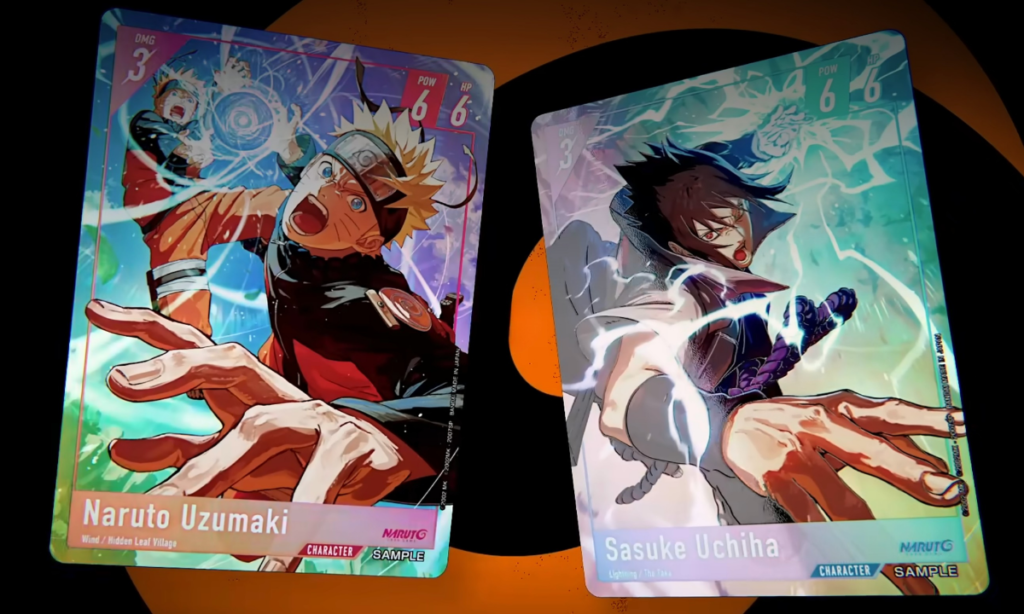
Well, well, well, another TCG enter the fight. Bandai just made a move that every TCG investor should be paying attention to, we certainly are. At the BANDAI CARD GAMES Next Plan Presentation on June 18, 2026, they officially announced the NARUTO CARD GAME (HUGE NEWS) a brand new, strategy-focused trading card game based on Masashi Kishimoto’s globally legendary Naruto franchise, with a simultaneous worldwide launch planned for Summer 2027 (Jun-Aug). The game made its world debut at Gen Con 2026 in Indianapolis this week, with its first public tutorial sessions, card reveals, and a full global event roadmap between now and launch.
Here at The TCG Times, we have been covering the rise of One Piece TCG as a serious investment market since the game launched, as it truly is something from a financial standpoint the TCG market has never seen before. And watching a second Bandai anime property enter the TCG space with the same publisher, a similar game structure, and a fanbase measured in the hundreds of millions naturally raises one very specific question for investors (yeah, the big money question, we know this is why you’re here): is this the next One Piece investment opportunity, or is it something more modest?
Our honest answer… it is neither the next One Piece nor a pass. It sits somewhere in between, and understanding exactly where it sits, and why, is the most valuable thing we can give you before the hype cycle builds through 2026 and into the 2027 launch window.
The IP Case: Genuinely Massive, But Not One Piece
Let us start with the raw numbers, because they matter. The Naruto manga sold over 250 million copies worldwide confirmed by Bandai’s own press release and placing it fourth on the all-time best-selling manga list globally, not to shabby if we don’t say so ourselves. The Naruto anime has been broadcast in over 80 countries and loved globally. The franchise’s global merchandise market was valued at $3.8 billion in 2025 and is projected to grow at 7.7% annually through 2034, for s how that ended years ago this is nothing short of impressive. These are not small numbers. This is one of the most commercially significant anime and manga franchises in history.
For Western investors specifically, there is an argument that Naruto’s cultural penetration exceeds even One Piece in certain markets, because for millions of Western fans who grew up in the 2000s, Naruto was the gateway manga. The series that introduced them to anime. The show they rushed home from school to watch, ourselves included. That gateway nostalgia is a specific and powerful type of emotional connection that drives collector spending in a way that is difficult to quantify but impossible to ignore, nostaliga is something we have spoken about regularly and almost always increases the value of specific TCG cards. The demographic sitting on that nostalgia, people now in their late 20s and early 30s with real disposable income (probably you reading this right now) is exactly the buyer profile that has driven Pokémon Base Set and original Yu-Gi-Oh prices to extraordinary levels over the past five years.
However: One Piece has 530 million copies sold. Dragon Ball has approximately 260 million. Why are we talking about Dragon Ball all of a sudden? Well, just wait a sec, and we will explain. The comparison to Dragon Ball Super TCG is directly relevant here, Dragon Ball entered the TCG market with similar IP scale to Naruto, published by Bandai, with a passionate global fanbase, and never produced the secondary market investment returns that One Piece has generated. Understanding why Dragon Ball Super TCG has a ceiling below One Piece TCG is the same framework for understanding where Naruto is likely to land. Both Dragon Ball and Naruto have enormous fanbases. Neither has One Piece’s combination of ongoing story momentum, 530 million copies, and the Netflix live-action moment that opened the floodgates to mainstream attention in 2023. We personally love Dragon Ball more than One Piece (chill pirate peeps, don’t kill us), but the TCG is never going to rival One Piece in terms of investment opportunities.
The Bandai Advantage: They Have Done This Before
One of the clearest reasons to take the Naruto Card Game seriously as an investment prospect, rather than dismissing it as another anime TCG that fails to break through, is the publisher. Bandai Card Games built the One Piece TCG from scratch into the fastest-appreciating major TCG market we have tracked. They are not guessing at how to do this, they are pros!
The structural decisions announced for the Naruto Card Game already mirror what made One Piece TCG investment-worthy from launch: simultaneous worldwide release (no 3-month Japan-first gap that fragments the market), a competitive infrastructure from day one (organised play/tournaments, store events, etc), and a game structure featuring a Leader card system similar to One Piece that creates a clear deck identity and character-driven gameplay. This is not a casual kitchen-table game dressed in Naruto branding. Bandai is building a competitive TCG with serious player infrastructure behind it.
The simultaneous global launch in particular is significant, it means the entire world’s collector demand concentrates on a single release window rather than being fragmented across a Japanese market and an international market. We have seen what this does for One Piece from 2026 onwards, and Naruto launches with this structure from day one, we are not surprised by this plan for release.
The Completed Story Problem – And Why It Matters for Investors
Here is the nuance most coverage of this announcement will miss, and it is genuinely important.
The One Piece manga is still running. Every new chapter that reveals a major character, a significant plot development, or a long-awaited confrontation creates a wave of community excitement that flows directly into card demand. The story is doing ongoing marketing work for the card game, for free (in concept), continuously. When a character gets a major moment in the manga, their cards move and so do our hands to our wallets.
The Naruto manga ended in 2014. Twelve years ago, the story is complete. Boruto: Naruto Next Generations and the newer Boruto: Two Blue Vortex continue the franchise, but the original series, the OG, the one that generated the 250 million copies and the global nostalgia is finished. This creates a fundamentally different demand dynamic for the card game. Without ongoing story reveals driving fresh waves of collector excitement, the Naruto Card Game’s long-term momentum will depend more heavily on nostalgia and organised play than on active narrative engagement.
This is the same dynamic that limits Dragon Ball Super TCG relative to One Piece (told you that Dragon Ball compassion makes sense), and it is the most honest structural argument for why Naruto TCG’s investment ceiling is likely below One Piece’s.
There was also a previous Naruto TCG, published by Upper Deck Entertainment from 2006, a game that eventually failed commercially. This is not a red flag for the new Bandai version, which is a categorically different product from a far superior publisher. But it is worth noting that the IP has attempted this before, which means the market has some existing context for what a Naruto TCG looks like when it does not work. Bandai’s execution capability is the meaningful difference.
What We Actually Expect: Hype, Correction, Then the Real Floor
Based on the pattern we have seen from One Piece, Palworld, and other recent TCG launches, here is our honest projection for the Naruto Card Game investment cycle:
Pre-launch and launch window (leading into Summer 2027): Significant hype build through the 2026 convention circuit, NYCC in October, PAX Australia, Paris Games Week, Lucca Comics & Games. Collector awareness grows steadily. Pre-orders begin, and early demand signals emerge. This is the window where sealed product speculation begins and first edition buzz builds. We felt investors tingle when we said “first edition”.
Launch hype peak (Summer 2027, weeks 1 to 8 post-launch): The largest wave of retail buying, secondary market activity, and content creator coverage. Singles and sealed product hit their hype premium. This is the sell window IF you are playing a short-term strategy, and we think this window will be a genuine, meaningful spike driven by the combination of fanbase scale, Bandai’s launch execution, and new collector excitement. Hype combining with FOMO = potentially big resale value.
Post-launch correction (approximately months 2 to 4): The hype normalises. Supply becomes clearer. Singles retract toward genuine demand levels. This correction is not a disaster, it is a normal market clearing event that happens after almost every significant TCG launch. We have spoken about it in our 90 Day Rule article (great read in our opinion). The investors who get hurt are the ones who bought at the hype peak expecting it to hold.
Long-term floor (twelve months post-launch and beyond): This is where the real investment case either builds or stalls, a bit of a make-or-break situation. If Bandai executes the organised play infrastructure, if the competitive scene develops, and if first edition sealed product genuinely goes out of print, the long-term hold case is real, even if the ceiling is below One Piece’s extraordinary trajectory.
Our Take: First Edition Is the Play, Singles Need an Exit Plan
The investment framework we would apply here is similar to our Delta Reign assessment, strong on the launch window, more cautious on the open-ended long hold without a clear thesis.
First edition sealed product: the most compelling investment in the Naruto Card Game. If the first set produces genuinely first-edition-stamped sealed product and Bandai’s One Piece TCG structure strongly suggests it will. This is the category with the clearest long-term appreciation case. OP-01 Romance Dawn at $100 USD retail is now $2,700-$4,344 USD. The Naruto Card Game’s first set will not hit those numbers, the IP ceiling is lower and the market is more aware of the opportunity this time. BUT first edition sealed from a Bandai anime TCG with 250+ million franchise copies behind it has a pretty credible multi-year hold case.
Singles: buy the hype, set your exit price before you buy in. The 90-day rule applies in full here, the real settled price of chase cards will not be visible until the launch excitement has cleared. Do not mistake hype-window pricing for long-term value.
The position sizing note: given that this is a brand new game with unconfirmed pull rates, unconfirmed rarity structures, and an ongoing question about whether the competitive scene will develop to the level that sustains long-term singles demand, apply the position sizing discipline we covered in our portfolio framework, this is not a max-conviction allocation.
The TCG Times’ Verdict: It Sits Between One Piece and Dragon Ball, And That Is Still Interesting
Our honest expectation is that the Naruto Card Game investment market lands somewhere between One Piece and Dragon Ball Super TCG over a three to five year horizon. Above Dragon Ball because of Naruto’s deeper Western fanbase penetration and Bandai’s improved execution capability. Below One Piece because of the completed story dynamic and the smaller raw IP footprint.
That is not a failure case by any means. A market that performs between two genuinely interesting investment alternatives is still worth paying attention to, particularly in the first edition sealed category, which has the clearest structural appreciation thesis and the least dependence on ongoing story momentum. This could be a golden opportunity to someone new to TCG investing.
Watch the convention circuit reveals through late 2026 carefully. The product structure, rarity tiers, and print philosophy that Bandai announces in December 2026 will tell you more than anything we can say right now about where the investment ceiling actually sits (although our estimates are usually solid). We will be covering every development here at The TCG Times as the roadmap unfolds.
Disclaimer: The TCG Times is a news and educational platform. All content provided is for informational purposes only and should not be construed as professional financial advice. Trading cards are high-risk, volatile assets. Past performance is not indicative of future results. Forward-looking assessments are speculative by nature. Always perform your own due diligence before making any financial decisions.