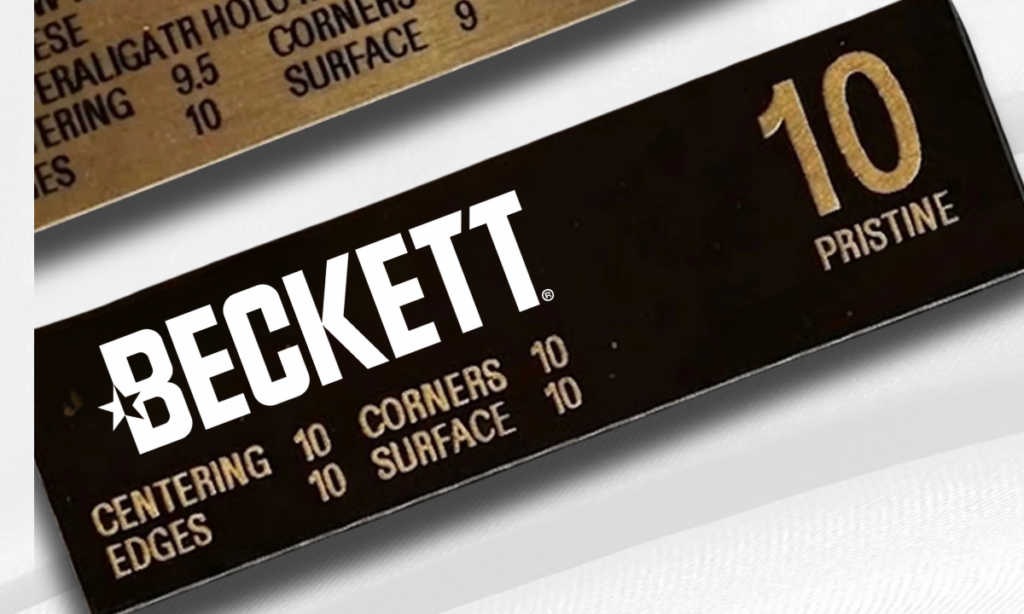
Pick up any BGS slab and you will see four numbers staring back at you alongside the overall grade. Most collectors glance at the big number in the middle and move on. The investors who actually understand what they are looking at examine all five. Why? Because those four sub-grades tell a story that the overall grade alone cannot, and that story is worth real money if you know how to read it.
Here at The TCG Times, we genuinely believe that understanding the BGS sub-grade system is one of the most overlooked edges available to TCG investors. It costs nothing to learn, a $0 investment if you will (bad joke, lets keep moving). It changes how you evaluate every BGS card you consider buying or selling. And once you see it clearly, you will wonder how you made grading decisions without it.
The System at a Glance
BGS (Beckett Grading Services), founded in 1999, was the grading company that pioneered the sub-grade concept, the idea that a card’s condition cannot be fully described by a single number, because a card might have exceptional corners and a surface issue, or be slightly off-centre with otherwise perfect edges. A single overall grade flattens that nuance. BGS shows you all of it.
Every BGS submission receives four individual sub-grades, each scored on a 1-10 scale in half-point increments (so you will see 9, 9.5, and 10, not anything in between). The four categories are:
Centering: how symmetrically the printed image sits within the card’s border. BGS measures this as a ratio on both front and back independently. 60/40 means the border on one side is 60% of the card’s total border width, the opposite side is 40%. Tighter is better.
Corners: the four physical points of the card. Under magnification at 400x (yes 400x!), BGS checks for whitening (the most common sign of wear on dark-bordered cards), fraying, dents, folds, scratches and any softening of the corner point. Corners are statistically the most common reason a card fails to achieve perfect sub-grades and in most cases, are easiest to identify..
Edges: all four edges examined for roughness, chipping, and dents. Vintage cards with bare cardboard edges show wear here much faster than modern cards with coated or foil borders, which is one reason vintage Black Labels are so extraordinary. Makes ya wish you didn’t rubberband your decks, OGs will understand.
Surface: scratches, print defects, staining, and loss of original gloss. This is the hardest sub-grade to self-assess accurately because surface wear is often invisible under normal light but catches dramatically when you tilt the card under a bright, angled lamp. If you ever see multiple scratch lines catch the light, that card will not achieve a 10 surface. Very hard to just “eyeball” it.
What Each Grade Level Actually Means
The overall BGS grade is derived from the four sub-grades, but it is not simply an average (yes, it’s weird, bear with us). The overall grade cannot exceed the lowest sub-grade by more than one point. That is the most important mechanical rule in the system for investors to understand. Still confused… we will walk you through it.
A card with sub-grades of 10/10/10/9 cannot receive an overall BGS 10, the lowest sub-grade of 9 means the maximum overall grade is 9 or 9.5 (BGS rounds based on the combination). This is why cards can receive a BGS 9.5 overall despite having three perfect 10 sub-grades, and it is why the specific sub-grade combination on a BGS 9.5 matters hugely to its market value.
The key grade thresholds and what they require:
BGS 10 Pristine Black Label: The holy grail, all four sub-grades must be exactly 10. Centering must be 50/50 on both front and back. Fewer than 5% of all BGS submissions achieve this. The black label is printed on the slab (replacing the standard gold label) to make the achievement immediately visible. This is arguably the best grade you can get across any grading company.
BGS 10 Pristine: requires at least three sub-grades of 10 and one sub-grade of 9.5. Still exceptional, still rare, but does not receive the Black Label. Commands a significant premium over BGS 9.5 but below the Black Label.
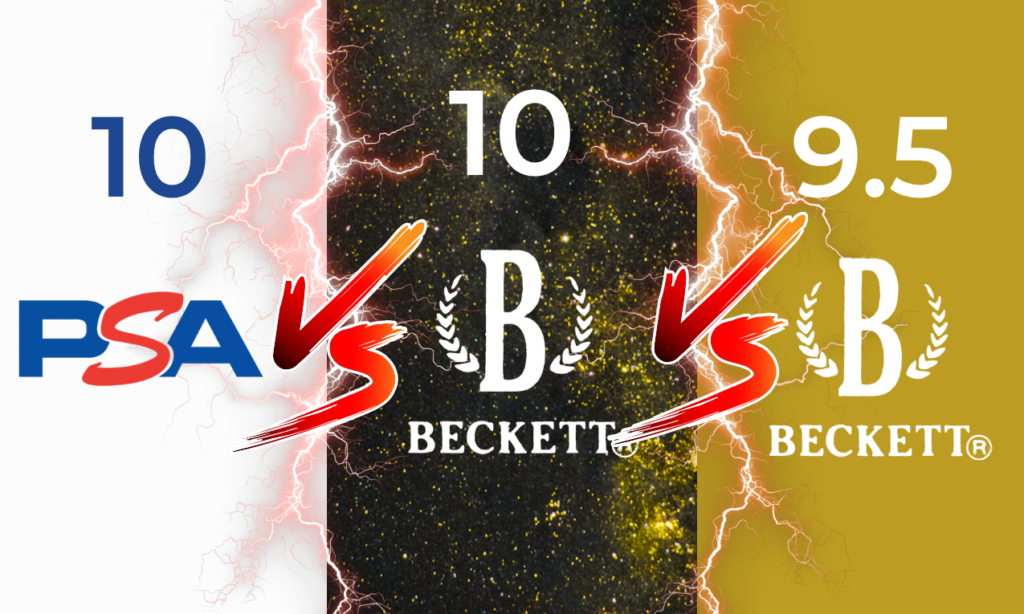
BGS 9.5 Gem Mint: the most common BGS high grade. Requires centering of 55/45 or better, with near-perfect corners, edges, and surface. As we covered in our PSA 10 vs BGS 9.5 comparison, this grade typically sells for 70-80% of PSA 10 value, closer to PSA 9 than PSA 10 in market pricing.
BGS 9 Mint: a genuinely good card with minor imperfections. Centering to 60/40. Typically sells for 50-65% of PSA 10 value.
Why the Sub-Grade Combination Changes the Price
Here is where it gets genuinely interesting for investors, and why two BGS 9.5 cards with the same overall grade can have meaningfully different market values due to sub-grades.
A BGS 9.5 with sub-grades of 10/10/10/9.5 is a very different card from one with 9.5/9/9.5/9.5. Both receive the same overall grade. We assume you see where this is going but for the slow ones in the group….
The first card, with three perfect 10 sub-grades, is a strong Black Label candidate if submitted fresh, has demonstrably excellent condition across most categories, and will attract buyers who understand the system. The second card has visible imperfections across multiple categories and will not cross over to PSA 10 easily if at all.
Experienced buyers actively look at the sub-grade breakdown before purchasing BGS cards, specifically because:
The crossover calculation. Only about 40% of BGS 9.5 cards cross over to PSA 10 when regraded. BGS 9.5s with higher sub-grade combinations (three 10s and one 9.5) cross over at significantly higher rates than BGS 9.5s with lower combinations. Knowing the sub-grades tells you whether a card is a realistic crossover candidate and therefore whether PSA 10 value is achievable.
The Black Label potential. A card that received BGS 9.5 with sub-grades of 10/10/9.5/10 missed Black Label by one sub-grade category. If you understand that the surface (9.5) was the limiting factor, you can assess whether a fresh submission, on a card that has since been properly stored, might achieve Black Label. This is a completely different investment thesis from a card that received 9/9.5/9.5/9.5 and was unlikely to hit Black Label regardless.
How to Read a BGS Slab in Five Seconds
When you pick up a BGS slab, here is the sequence:
- Note the label colour. Black = Black Label Pristine 10. Gold = all other grades.
- Read the overall grade in the centre.
- Check the four sub-grades. Note which is the lowest, this is the card’s limiting factor.
- Check if the sub-grades are all 9.5 or above. This tells you the crossover and Black Label potential.
- Ask: does this sub-grade combination tell a consistent story? A card with 10/10/10/8.5 has a specific surface issue that tells you something. A card with 9.5/9.5/9.5/9.5 is uniformly very good without being exceptional in any category.
The Investor Edge
The BGS sub-grade system gives you information that PSA simply does not provide. PSA tells you a card met its standard for a grade. BGS tells you where it met that standard, where it fell short, and by how much. That information changes how you price every BGS card you consider buying and how you evaluate the potential of cards you are thinking of submitting.
The collectors and investors who use this information actively and knowingly, who buy BGS 9.5 cards with 10/10/9.5/10 sub-grades at prices reflecting the overall 9.5 grade rather than their realistic Black Label or crossover potential, are finding genuine pricing inefficiencies in a market where most buyers look at one number and make a decision.
Disclaimer: The TCG Times is a news and educational platform. All content provided is for informational purposes only and should not be construed as professional financial advice. Grading standards and pricing are subject to change. Always verify current information with grading companies directly before making financial decisions.