The Charizard Effect: Why One Dragon Dictates the Pokémon Market
In the world of traditional finance, analysts look to “leading indicators” to forecast the health of the economy. They watch the S&P 500, the strength of the US Dollar, or the price of Gold. In the Pokémon Trading Card Game (TCG) market, we have our own index, and it breathes fire.
We call it the “Charizard Effect.” To the casual observer, Charizard is simply a popular fire-breathing dragon from a 1990s video game. To the professional investor, Charizard is a “Blue Chip” asset that acts as the primary driver of market sentiment, liquidity, and price discovery. If you want to understand where the Pokémon market is headed, you don’t look at the latest set mechanics or the competitive meta-game. You look at the dragon.
The Gold Standard of the TCG Economy
To understand why one character holds such disproportionate power, we must look at the concept of “The Gold Standard.” For decades, the global economy was backed by gold because it was scarce, universally recognized, and held a psychological value that transcended borders. Charizard occupies the exact same space in the Pokémon ecosystem.
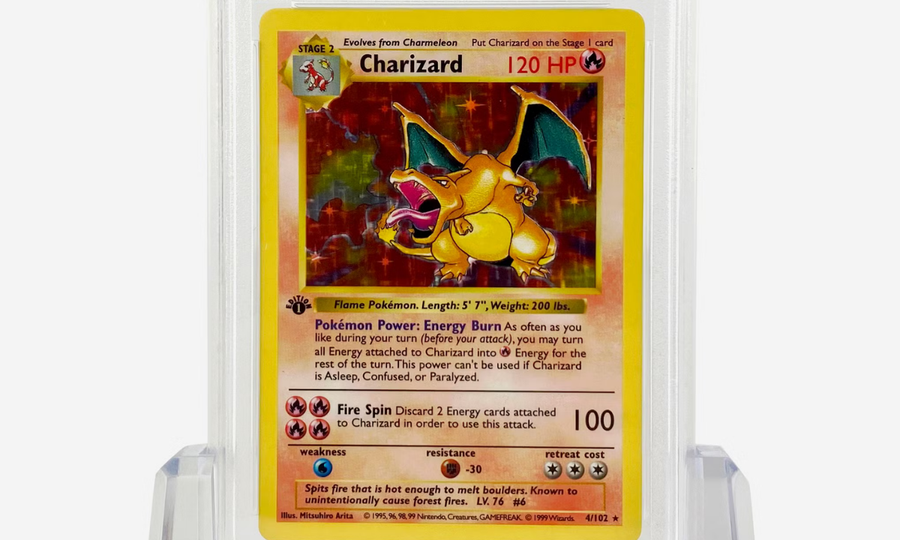
Since the 1999 Base Set release, Charizard has been the “trophy” of the hobby. This isn’t just about nostalgia; it’s about established market history. When a new investor enters the space with $50,000 to deploy, they rarely look for niche “waifu” cards or obscure Japanese promos. They look for a high-grade Base Set Charizard. This constant influx of high-level capital creates a “price floor” for the character that other Pokémon simply do not have. Because Charizard is the most liquid asset in the game, it becomes the benchmark against which all other cards are measured. If the price of a PSA 10 1st Edition Base Set Charizard is rising, it signals to the market that “Big Money” is confident. If it begins to plateau or dip, it is often a harbinger of a broader market cooling.
Charizard as a Leading Indicator: The 2020 Case Study
The most dramatic example of the Charizard Effect occurred during the massive market expansion of 2020 and 2021. While many attribute the “boom” to global lockdowns and influencer hype, the data shows that Charizard was the spark that lit the fuse.
Before the broader market saw 500% gains, the high-end Charizard market began to move. We saw record-breaking sales of vintage Charizards at major auction houses like Heritage and Goldin. This created a “Halo Effect.” Collectors who realized they could no longer afford a vintage Charizard began to move their capital into “The Next Best Thing”—which, predictably, were other Charizards. They moved into Burning Shadows, Hidden Fates, and Shining Legends. Once those Charizards became “unreachable,” the capital finally trickled down into other species like Lugia, Umbreon, and Rayquaza.
This trickle-down effect is the core of the Charizard Effect. Charizard acts as the “Engine” of the train. When the engine moves, the rest of the cars (the other Pokémon) eventually follow. As an investor, watching the “Charizard Index” allows you to see the wave before it hits the rest of the shore.
The “Chase Card” Paradigm and Set Performance
The Pokémon Company International (TPCi) is well aware of the Charizard Effect, and they use it as a tool to dictate the success of modern expansions. From a financial perspective, a Pokémon set’s “Box Value” is often tied directly to whether or not it contains a “Chase Charizard.”
Consider the difference between a set like Evolving Skies and a set like Darkness Ablaze. While Evolving Skies succeeded through the sheer power of “Eeveelution” Alt-Arts, Darkness Ablaze was carried almost entirely on the back of the Charizard VMAX. Without that single dragon, the set would likely have been a financial failure for retailers.
This creates a “Concentration Risk” for investors. When you buy into a modern set that is “Charizard-heavy,” you are betting on the popularity of a single character to sustain the value of the entire product. If the market becomes over-saturated with Charizard prints—as we saw during the Sword & Shield era—the “premium” of the dragon can begin to diminish. However, history shows that even an over-printed Charizard tends to outperform a “rare” version of a less popular Pokémon over a five-year horizon.
The Psychological Moat: Why the Dragon Doesn’t Die
Critics of the Pokémon market often argue that the obsession with Charizard is a bubble that will eventually burst. They point to “Power Creep” or the rise of new fan-favorites like Greninja or Lucario. But this ignores the “Psychological Moat” that Charizard has built over twenty-five years.
Investing is, at its core, a game of belief. For a market to remain stable, the participants must believe that their assets will be desirable to the next generation of buyers. Charizard has achieved “Cross-Generational Dominance.” The 35-year-old investor wants the Charizard they couldn’t afford in 1999. The 10-year-old collector wants the Charizard they saw on a YouTube break yesterday. When you have both “Old Money” and “New Blood” chasing the same asset, you have a recipe for permanent market relevance.
This is why, even in a “Bear Market,” Charizard is often the last to drop and the first to recover. It is the “Flight to Quality” asset. When the market gets shaky, investors sell their speculative “alt-arts” and park their cash in a graded Charizard. It is the safest harbor in a storm.
The Grading Pop Report and the “Gem Mint” Premium
If you are looking to exploit the Charizard Effect for ROI, you must understand the nuance of the “Pop Report.” Because everyone knows Charizard is valuable, everyone grades their Charizards. This has led to a massive inflation in the “Population” of graded Charizards from the modern era.
For vintage cards, a PSA 10 is a true rarity. For modern sets like Champion’s Path or Hidden Fates, the “10” population can be in the tens of thousands. This is the “Charizard Trap.” Just because a card features the dragon doesn’t mean it’s a guaranteed winner. In the modern era, the Charizard Effect is moving away from “The Character” and toward “The Art.” The market is beginning to prioritize unique artistic renditions—like the Team Up Special Art or the Brilliant Stars Alt-Art—over the standard “shiny” versions.
Final Verdict: Respect the Dragon
You don’t have to like Charizard to be a successful Pokémon investor, but you do have to respect the dragon’s shadow. It dictates the price of booster boxes, the volume of grading submissions, and the overall temperature of the hobby.
At The TCG Times, we recommend using Charizard as your primary market barometer. Before you make a major move into a different area of the market, ask yourself: What is Charizard doing right now? If the dragon is stagnant, the rest of the market is likely to follow suit. If the dragon is running, it’s time to look for the “lagging” assets that haven’t caught the flame yet.
The Pokémon market is a complex machine with thousands of moving parts, but it only has one heart. As long as that heart is a fire-breathing dragon, the Charizard Effect will remain the most important rule of TCG finance.
Disclaimer: The TCG Times is a news and educational platform. All content provided is for informational purposes only and should not be construed as professional financial advice. Trading cards are high-risk, volatile assets. Past performance is not indicative of future results. Always perform your own due diligence before making any financial decisions.